
Key Takeaways
- Quality assurance (QA) is essential for contact centers to ensure high performance and customer satisfaction.
- Automated QA software uses AI to evaluate all customer interactions, enhancing consistency and providing real-time insights.
- AI QA monitoring and QA analytics enable proactive performance management, ensuring compliance and identifying training opportunities.
- The future of automated QA focuses on predictive analytics, allowing for optimization before issues arise.
- Automation in QA enhances accuracy, empowers coaching, and supports data-driven decisions for improved service quality.
Estimated reading time: 6 minutes
Table of contents
- What Is Automated QA?
- How Automated QA Works
- 1. From Manual Audits to Continuous Monitoring
- 2. Improved Accuracy Through AI Intelligence
- 3. Compliance and Risk Reduction
- 4. Empowering Coaching and Continuous Improvement
- 5. Unified Analytics for Smarter Decisions
- The Future of Automated QA
- Key Takeaways
- FAQs
- Quality control that never sleeps.
- You May Also Be Interested In…
Quality assurance (QA) is the backbone of every contact center — ensuring agents meet performance standards, follow procedures, and deliver excellent customer experiences.
Traditionally, QA teams manually reviewed a small percentage of calls each week. But in 2026, that approach no longer scales.
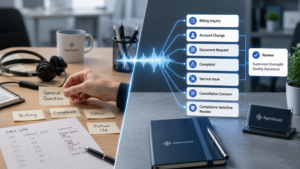
Enter automated QA software — intelligent systems that evaluate 100% of customer interactions with precision, speed, and consistency. Through AI QA monitoring and advanced QA analytics, contact centers can now measure performance objectively, enforce compliance effortlessly, and coach agents proactively.
What Is Automated QA?
Automated QA software uses artificial intelligence to monitor, evaluate, and score customer interactions across voice, chat, and email channels.
Instead of relying on human reviewers to sample calls, AI listens to every conversation — analyzing tone, keywords, sentiment, and compliance triggers in real time.
The system then generates performance reports and QA analytics dashboards, highlighting strengths, weaknesses, and training opportunities.
This automation shifts QA from reactive auditing to proactive performance management — saving time while improving consistency.
How Automated QA Works
Behind the scenes, automated QA software integrates speech recognition, Large Langauge Models (LLMs), and emotion detection models to analyze conversations end-to-end.
Here’s the typical process:
- Capture & Transcribe: AI converts spoken calls or written chats into structured data using speech-to-text engines.
- Analyze Content: AI QA monitoring scans for compliance statements, empathy markers, and policy violations.
- Score Performance: Each interaction is graded against pre-defined KPIs such as tone, accuracy, and resolution.
- Generate Reports: QA analytics dashboards summarize agent performance, call quality, and trend insights.
- Trigger Coaching: The system flags specific moments for feedback or creates automated training clips for review.
With this workflow, QA teams can focus less on finding errors and more on improving behavior.
1. From Manual Audits to Continuous Monitoring

Traditional QA reviews only a fraction of interactions — often less than 2%.
That leaves potential quality issues undetected until they become customer complaints.
Automated QA software solves this by analyzing every call automatically.
It ensures continuous AI QA monitoring and immediate feedback, giving leaders near real-time visibility into service quality.
This shift delivers faster insights, greater transparency, and fairer agent evaluations across the board.
2. Improved Accuracy Through AI Intelligence
Human QA reviewers, while skilled, are limited by fatigue and subjectivity.
AI removes that variability.
Automated QA software applies consistent scoring models and uses QA analytics to identify outliers or anomalies objectively.
Its algorithms detect sentiment shifts, compliance lapses, or miscommunication instantly — with accuracy levels surpassing manual reviews.
For example, if an agent forgets a disclosure or fails to express empathy, AI QA monitoring flags the issue within minutes.
This precision ensures that every customer interaction is evaluated fairly and consistently.
3. Compliance and Risk Reduction
In heavily regulated industries like finance or healthcare, a single missed statement can lead to penalties.
Compliance QA tools help reduce risk by automatically verifying that required phrases are spoken, privacy rules are followed, and sensitive data is protected.
Automated systems can redact personally identifiable information (PII), ensure adherence to scripts, and provide audit trails that stand up to regulatory scrutiny.
The result: better compliance management and peace of mind for leadership.
4. Empowering Coaching and Continuous Improvement
The goal of QA isn’t to catch mistakes — it’s to create better agents.
Automated QA software uses insights from QA analytics to pinpoint where each agent excels or struggles.
Supervisors receive automatic recommendations for training, while agents get instant access to notes showing best practices. Instead of waiting weeks for performance reviews, feedback becomes immediate and actionable.
This continuous improvement loop keeps morale high and turnover low.
5. Unified Analytics for Smarter Decisions

With all interactions analyzed and scored, QA analytics provides a data-driven view of performance across the organization.
Managers can filter by team, product, sentiment, or compliance score to find trends and root causes.
Integrated with CRM and workforce systems, automated QA software links quality data with business outcomes like retention, upsell rates, and CSAT.
This holistic visibility helps decision-makers move from guessing to knowing.
The Future of Automated QA
The next generation of AI QA monitoring is moving toward predictive analytics — not just identifying what happened, but why.
Future compliance QA tools will integrate sentiment forecasting and anomaly detection, allowing managers to spot declining performance before it affects customers.
Combined with AI coaching assistants and real-time feedback, QA will evolve from oversight to optimization.
In short, the future of QA is fully automated, deeply intelligent, and completely integrated.
Key Takeaways
- Automated QA software evaluates every customer interaction with AI-driven precision.
- AI QA monitoring enables continuous, real-time oversight instead of manual sampling.
- QA analytics deliver data-driven insights for training, performance, and decision-making.
- Compliance QA tools ensure consistent, secure, and regulation-ready communication.
Automation doesn’t replace quality control — it perfects it.
FAQs
It’s the use of automated QA software and AI QA monitoring to evaluate all customer interactions automatically, ensuring consistent quality and compliance.
AI eliminates bias and fatigue by using QA analytics to measure tone, compliance, and sentiment objectively — scoring calls faster and more accurately than humans.
Key features include compliance QA tools, emotion analysis, customizable scorecards, automated feedback delivery, and integrations with CRM and workforce systems.
Quality control that never sleeps.
Discover how AgentAssist.com automated QA software delivers real-time AI QA monitoring, compliance assurance, and actionable insights for a new era of customer excellence.