Key Takeaways
- Conversation analytics software uses AI to analyze customer interactions in real time, providing insights beyond traditional call monitoring.
- It captures audio and text, transcribes conversations, and detects emotional tones for deeper understanding.
- The software improves customer understanding, enhances coaching, ensures compliance, and facilitates faster decision-making.
- Unlike call monitoring, conversation analytics examines entire datasets for systemic trends rather than isolated calls.
- Integrating conversation analytics software enriches daily operations by embedding intelligence into the workflow.
Estimated reading time: 5 minutes
Table of contents
- What Is Conversation Analytics Software?
- How Conversation Analytics Works
- Key Benefits of Conversation Analytics Software for Call Centers
- AI’s Role in Conversation Intelligence
- Conversation Analytics vs. Call Monitoring
- Integrating Analytics Into Daily Operations
- Key Takeaways
- FAQs
- Hear more than words — understand meaning.
- You May Also Be Interested In…
Every phone call tells a story — one filled with emotion, tone, and context that often goes unnoticed. For decades, call centers relied on supervisors to listen to a handful of recordings and guess what customers truly felt. But in 2026, that guesswork is gone.
Modern conversation analytics software listens, learns, and reveals what happens in every interaction — across thousands of calls, emails, and chats. It doesn’t just record what was said; it understands how it was said, detecting tone shifts, pauses, and emotional cues invisible to human ears.
This technology, powered by AI call analytics and AI speech analytics, gives organizations the kind of insight once reserved for intuition — but now measurable, repeatable, and scalable.
What Is Conversation Analytics Software?
At its core, conversation analytics software uses artificial intelligence to analyze customer interactions in real time or post-call. It transcribes spoken conversations, detects emotional tone, and maps communication patterns to extract actionable insights.
Unlike traditional call monitoring, which focuses on compliance and quality control, conversation analytics digs deeper — revealing the emotional and behavioral signals that shape customer satisfaction, loyalty, and agent performance.
Through natural language processing, the software identifies what customers truly mean — not just what they say.
How Conversation Analytics Works
Behind every modern analytics platform lies a powerful engine that combines AI speech analytics and large language models (LLMs). Here’s how it typically operates:
- Capture: The software records or integrates with existing systems to capture audio and text interactions across phone, chat, and email channels.
- Transcribe: Using AI call analytics, the system converts speech into text with near-human accuracy, even recognizing accents, slang, and emotional tone.
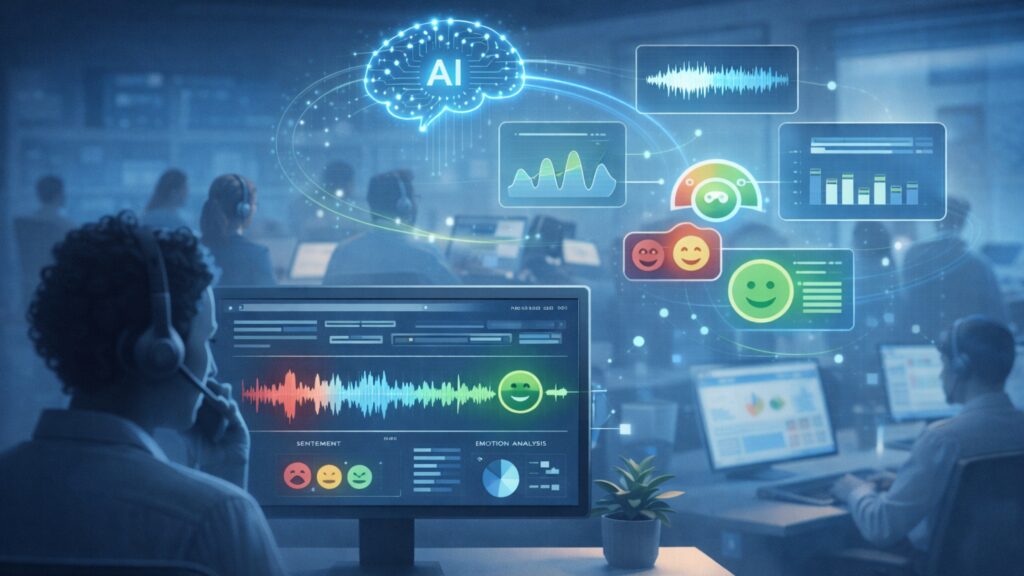
- Analyze: It detects keywords, sentiment changes, pacing, and silence — all clues that reveal customer mood and intent.
- Visualize: Insights are displayed through dashboards and call center analytics tools, showing trends like customer frustration, agent performance, and emerging issues.
The outcome is total visibility. Instead of sampling a few calls, managers can now understand every conversation — identifying risks, opportunities, and emotional drivers behind outcomes.
Key Benefits of Conversation Analytics Software for Call Centers
The rise of conversation analytics software represents one of the biggest leaps in customer experience management. Its impact extends across operations, training, and leadership.
| Benefit | Description |
| Improved Customer Understanding | AI call analytics identifies what topics, tones, or emotions correlate with satisfaction or churn. |
| Smarter Coaching | Managers use call center analytics tools to pinpoint where agents struggle or excel, leading to more targeted coaching. |
| Compliance and Risk Reduction | AI speech analytics automatically flags policy violations or missed disclosures in real time. |
| Faster Decision-Making | Executives can base strategy on real data from thousands of conversations instead of relying on anecdotal reports. |
| Enhanced Customer Experience | By identifying emotional triggers, businesses can proactively design smoother, more empathetic interactions. |
Ultimately, the value lies in connection: understanding what customers feel and why — at scale.
AI’s Role in Conversation Intelligence

The evolution from manual review to AI call analytics is about more than automation — it’s about intelligence.
These insights fuel predictive models that forecast customer behavior, allowing call centers to act before issues escalate. Whether it’s identifying potential cancellations, detecting compliance risks, or recognizing upsell opportunities, conversation analytics software gives leaders foresight that once felt impossible.
Conversation Analytics vs. Call Monitoring
The terms “conversation analytics” and “call monitoring” are often used interchangeably, but they serve very different purposes.
- Call monitoring focuses on evaluating specific calls for quality, compliance, and script adherence. It’s reactive and sample-based.
- Conversation analytics software examines entire datasets of calls, providing organization-wide insights. It’s proactive, continuous, and emotion-aware.
In short, call monitoring listens to events; conversation analytics listens to patterns.
This difference transforms how leaders think about coaching, performance, and customer satisfaction. Instead of reacting to isolated errors, they can see systemic trends and build strategies that create consistency across teams.
Integrating Analytics Into Daily Operations
Adopting conversation analytics software isn’t just about buying a tool — it’s about embedding intelligence into the rhythm of daily work.
Supervisors use dashboards from call center analytics tools to prioritize coaching moments. Quality teams replace manual reviews with automated performance scoring. Marketing teams mine conversation data for product feedback.
Meanwhile, AI call analytics feeds insights into CRM systems, ensuring that agents enter every conversation with full customer context. It’s not just technology — it’s transformation in action.
Key Takeaways
- Conversation analytics software gives full visibility into every customer interaction, beyond basic transcription.
- AI call analytics and AI speech analytics uncover tone, sentiment, and behavioral patterns that drive satisfaction and performance.
- Call center analytics tools empower leaders to coach smarter, act faster, and understand customers on a deeper level.
The future of contact centers belongs to those who don’t just hear conversations — they analyze them.
FAQs
It’s used to analyze customer interactions across voice, chat, and email. The software helps businesses understand sentiment, detect trends, ensure compliance, and enhance overall performance.
AI call analytics and AI speech analytics add emotional intelligence to data — interpreting tone, pacing, and context to reveal meaning beyond words.
Call monitoring evaluates individual calls for compliance, while conversation analytics software analyzes all interactions collectively to uncover patterns, behavior, and actionable insights.
Hear more than words — understand meaning.
Discover how AgentAssist’s conversation analytics software uses AI to analyze tone, sentiment, and behavior across every customer interaction.