Key Takeaways
- Call classification and call disposition serve different purposes in organizing customer conversations.
- Call disposition records the outcome selected by an agent, while call classification categorizes interactions based on reason, intent, and topic.
- Manual disposition may lead to inconsistencies, whereas AI call classification provides deeper insights and improves reporting accuracy.
- Combining call classification with traditional disposition enhances QA review, coaching, and operational decision-making.
- AgentAssist.com offers AI-driven call classification to support comprehensive analysis and better understanding of customer interactions.
Estimated reading time: 14 minutes
Table of contents
- What Is Call Disposition?
- What Is Call Classification?
- Call Classification vs. Call Disposition: The Main Difference
- Why Manual Call Disposition Alone Can Create Reporting Gaps
- How AI Call Classification Improves Call Reason Analytics
- Where Call Disposition Still Fits
- How Call Classification and Call Disposition Work Together
- Benefits of Moving Beyond Basic Disposition Codes
- Common Mistakes Contact Centers Make With Call Disposition
- What to Look for in AI Call Classification Software
- How AgentAssist.com Helps Contact Centers Improve Classification and Reporting
- Key Takeaways
- FAQ
- Ready to move beyond basic disposition codes?
- Helpful Resources
- You May Also Be Interested In…
Call classification and call disposition are both used to organize customer conversations, but they are not the same thing. Call disposition usually refers to the outcome or reason code selected by an agent after a call. Call classification is a broader, more structured way to categorize customer conversations based on call reason, customer intent, topic, issue type, risk indicators, or business workflow.
For contact center leaders, the difference matters. If reporting depends only on manual disposition codes, the data may be incomplete, inconsistent, or too limited to guide better decisions. Agents may rush through after-call work, choose broad categories, or select different codes for similar conversations. Over time, that can make it harder to understand why customers are calling and what operational changes may be needed.
AI call classification software helps contact centers move beyond basic call disposition. Instead of relying only on what an agent selects after the conversation, AI-powered classification can help organize calls using configured categories, keywords, conversation context, customer intent signals, and call reason analytics.
AgentAssist.com offers Call Classification as part of its broader contact center AI platform. This supports call-classification and reporting workflows without presenting disposition updates as a separate standalone product. The goal is to help businesses understand why customers are contacting them, identify trends earlier, and turn conversation data into more useful insights for operations, QA, coaching, compliance review, case management, and reporting.
What Is Call Disposition?
Call disposition is the label, outcome, or reason code assigned to a customer interaction, usually after the conversation ends. In many contact centers, agents select a disposition code during after-call work to summarize what happened.
Common call disposition examples include:
- Resolved
- Escalated
- Follow-up required
- Billing inquiry
- Technical support
- Complaint
- Cancellation request
- Account update
- Payment issue
- No answer
- Transferred
- Callback scheduled
Call disposition is useful because it gives the business a quick way to organize calls. Managers can look at disposition reports to see how many calls were resolved, how many required follow-up, or how many involved a certain type of request.
However, call disposition has limitations. Because it often depends on manual agent selection, it can become inconsistent. One agent may choose “billing inquiry,” while another may choose “payment issue” for a similar conversation. One agent may select “resolved,” even though the call also included a complaint or escalation concern. Another agent may rush through the disposition step because they need to move to the next call.
That does not mean call disposition is bad. It means disposition codes are only one layer of call reporting.
What Is Call Classification?
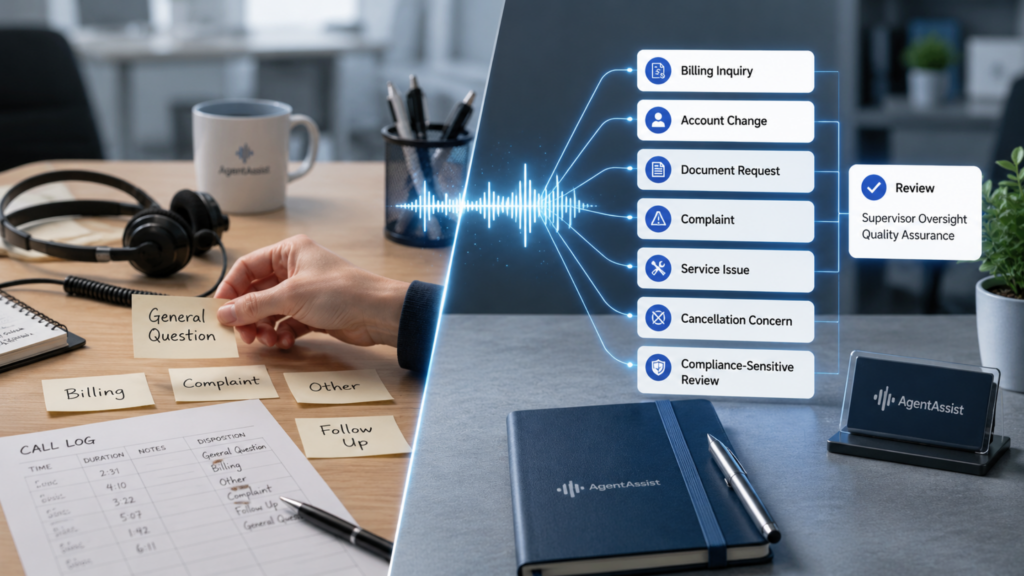
Call classification is the process of categorizing customer conversations into meaningful groups based on what happened during the interaction. These categories may include call reason, customer intent, topic, issue type, product area, service need, complaint category, escalation pattern, or compliance-sensitive language.
Call classification can include categories such as:
- Billing confusion
- Payment assistance
- Account verification
- Product question
- Service issue
- Cancellation concern
- Complaint language
- Escalation request
- Required disclosure review
- Documentation request
- Fraud-risk conversation
- High-friction customer experience
Call classification is broader than call disposition because it is not limited to one final outcome. A single call may include several important signals. For example, a customer may call about a billing issue, mention cancellation, express frustration about a prior interaction, and require follow-up from a supervisor.
If that call is only marked as “billing inquiry,” leadership may miss the bigger picture. Call classification helps contact centers capture more useful detail.
Call Classification vs. Call Disposition: The Main Difference
The simplest way to understand the difference is this:
- Call disposition explains how the call was labeled after it ended.
- Call classification helps explain what the call was actually about.
- Call disposition is often agent-selected. Call classification can be automated or AI-assisted based on the conversation itself.
- Call disposition often focuses on the final outcome. Call classification can identify multiple topics, reasons, and patterns inside the same conversation.
- Call disposition is useful for basic reporting. Call classification is useful for deeper analytics, QA review, coaching, trend detection, and operational decision-making.
Here is a practical example.
A customer calls because they were charged twice. During the call, they also mention that they tried to resolve the issue through self-service but could not find the right option. The agent resolves the billing issue and selects “resolved” as the disposition.
That disposition is technically true, but it does not show the full story.
A stronger classification structure may identify:
- Billing issue
- Duplicate charge
- Self-service failure
- Customer frustration
- Resolved on first contact
- Potential process improvement opportunity
This gives the contact center better data. It shows not only that the issue was resolved, but also why the customer called and where the business may need to improve.
Why Manual Call Disposition Alone Can Create Reporting Gaps
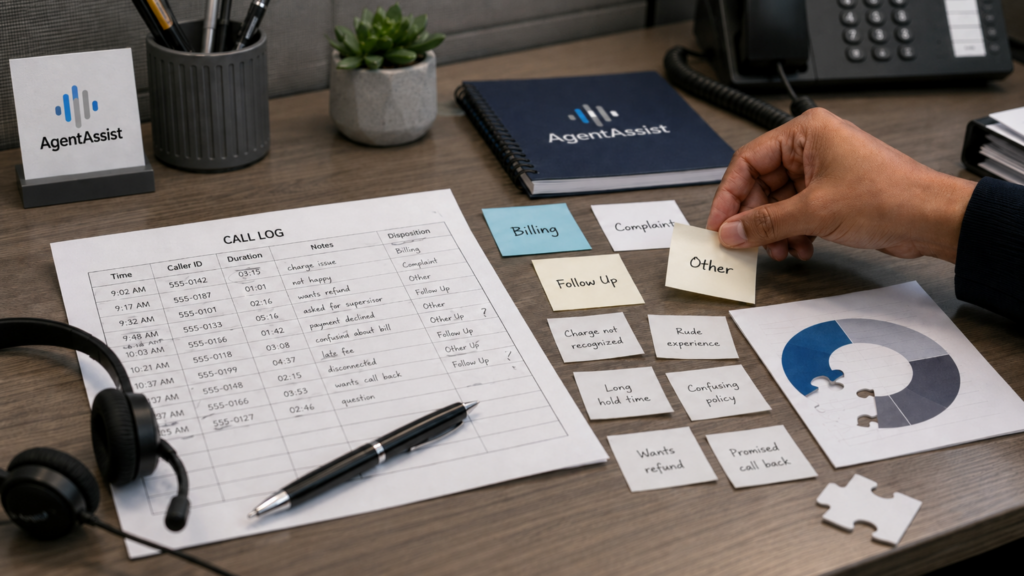
Manual call disposition can help organize calls, but it often creates reporting gaps when used by itself.
One issue is inconsistency. Agents may interpret disposition codes differently. If the categories are too broad, different call types may get grouped together. If the categories are too detailed, agents may select the wrong option or choose the fastest one.
Another issue is incomplete context. A call may have more than one reason, but many disposition systems only allow one final code. That can hide important patterns.
A third issue is after-call pressure. Agents often want to complete wrap-up quickly. If documentation slows them down, they may choose a disposition that is close enough rather than fully accurate.
These gaps can affect more than reports. They can influence staffing decisions, training priorities, customer experience improvements, QA reviews, and compliance-risk review.
When leaders cannot trust the accuracy of call reason data, it becomes harder to know which problems are growing and which workflows need attention.
How AI Call Classification Improves Call Reason Analytics
AI call classification software helps improve call reason analytics by organizing conversations based on configured criteria and conversation content. Instead of only depending on manual codes, contact centers can use AI-assisted classification to identify patterns across a much larger set of interactions.
This can help answer questions such as:
- Why are customers calling most often?
- Which issues are increasing over time?
- Are certain call reasons tied to longer handle times?
- Are complaints connected to a specific process?
- Are agents receiving repeated questions about the same policy?
- Are certain call types more likely to require escalation?
- Which topics should be reviewed by QA or supervisors?
- Which issues may need updated self-service content?
AgentAssist.com Conversation Analytics platform supports this type of workflow by helping teams search conversations, use filters, create saved searches, review calls, extract insights, and generate customized reports.
This matters because contact center leaders need more than call volume. They need to understand what the calls mean.
Where Call Disposition Still Fits
Call disposition still has a role in contact center operations. It can provide a fast, simple way for agents to record outcomes after a call. It can also support CRM workflows, ticketing updates, callback queues, and basic operational reporting.
Call disposition may be useful for tracking:
- Whether the call was resolved
- Whether follow-up is needed
- Whether the customer was transferred
- Whether a case was created
- Whether the interaction ended in cancellation
- Whether the issue required escalation
- Whether a callback was scheduled
The problem is not disposition itself. The problem is relying on disposition alone to understand the full customer conversation.
The stronger model is to use disposition and classification together.
Disposition can capture the final outcome. Classification can capture the reason, intent, topic, and patterns behind the interaction.
How Call Classification and Call Disposition Work Together
Call classification and call disposition should not be treated as enemies. They can work together to create stronger contact center reporting.
A practical workflow may look like this:
- A customer calls the contact center.
- The agent handles the conversation.
- The agent selects a disposition code after the call.
- AI call classification analyzes the conversation based on configured categories, keywords, topics, call reasons, and customer intent signals.
- The call is grouped into one or more meaningful categories.
- Supervisors, QA leaders, compliance teams, and operations managers review reports, dashboards, saved searches, or flagged calls.
- The business uses those insights to improve training, workflows, scripts, self-service content, coaching, and customer experience.
This workflow gives leaders a more complete view. The agent’s disposition still matters, but the organization is not limited to that single manual code.
Benefits of Moving Beyond Basic Disposition Codes
Better Reporting Accuracy
When calls are classified based on what actually happened in the conversation, contact centers can build more useful reporting. This helps leaders avoid making decisions based on incomplete or overly broad disposition data.
For example, a report that only says “billing inquiry” may not be enough. A classification report can show whether billing calls are about payment confusion, duplicate charges, refund requests, invoice language, late fees, or account access.
That level of detail helps managers act with more confidence.
Stronger QA Review
Call classification can help QA teams find specific types of interactions faster. Instead of randomly sampling a small set of calls, QA leaders can review targeted categories.
For example, QA teams may want to review:
- Cancellation-related calls
- Complaint calls
- Long calls with unresolved issues
- Calls involving required disclosures
- Calls with escalation language
- Calls tied to specific products or services
- Calls where agents may need additional coaching
AgentAssist.com Automated QA platform supports customized automated scorecards and quality monitoring workflows. When call classification connects with QA, teams can review more relevant interactions and create more useful feedback.
More Focused Coaching
Supervisors need to know where agents need support. Manual disposition codes may not provide enough detail for coaching.
Call classification can help identify patterns such as:
- Agents struggling with certain call types
- Repeated customer confusion around the same process
- Calls that frequently require supervisor help
- Topics that lead to longer handle times
- Interactions where agents may need clearer guidance
Agent coaching becomes more specific when supervisors can connect performance feedback to real conversation categories.
Faster Escalation Review
Some calls need quick review. These may include customer complaints, sensitive issues, compliance-risk topics, service failures, or fraud-risk conversations.
AgentAssist.com Case Management solution supports alerts and notifications for customized cases related to compliance, service, fraud, risk, and other selected criteria. It also helps supervisors review flagged calls, classify non-issues, and escalate concerns with fewer manual steps.
This is where call classification becomes operational. It helps teams identify which conversations may need attention, not just which calls happened.
Better Customer Experience Insights
Call classification helps contact centers see customer friction more clearly.
If many calls are classified around the same issue, the problem may not be the agents. The problem may be a confusing policy, unclear email, broken self-service flow, product issue, or billing process.
This gives customer experience leaders better insight into what customers are actually trying to accomplish.
Common Mistakes Contact Centers Make With Call Disposition
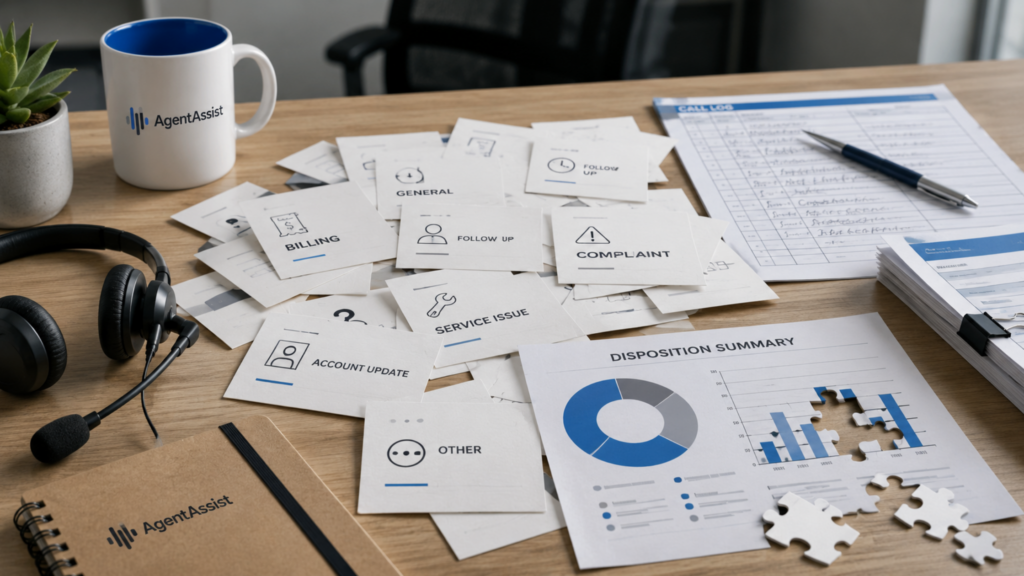
Many contact centers already use disposition codes, but they do not always get full value from them.
Common mistakes include:
- Creating too many disposition codes
- Using categories that overlap
- Relying on one broad final outcome
- Letting each agent interpret codes differently
- Failing to review disposition accuracy
- Not connecting disposition data to QA or coaching
- Treating disposition reports as complete customer insight
- Ignoring calls that include multiple issues
- Using codes that do not match real customer language
- Keeping old codes that no longer reflect current workflows
These problems can make reports look organized while still hiding the truth.
A better approach is to simplify manual disposition where needed and use AI call classification to create deeper, more consistent insight.
What to Look for in AI Call Classification Software
When evaluating AI call classification software, contact center leaders should look for a platform that helps organize conversations and connect those insights to action.
Important capabilities include:
- Custom call categories
- Call reason analytics
- Customer intent classification
- Automated call tagging
- Searchable conversations
- Conversation filters
- Saved searches
- Custom dashboards
- Custom reports
- Automated QA workflows
- Case management workflows
- Coaching workflows
- Call summarization
- Secure handling of sensitive information
- Alerts and notifications
AgentAssist.com fits this model because Call Classification is part of a broader platform. It connects with Conversation Analytics, Analytics, Automated QA, Agent Coaching, Case Management, Call Summarization, Real-Time Assist, and other contact center AI capabilities.
This is important because classification data is most useful when it leads somewhere. A label alone does not improve the contact center. But a label connected to reporting, QA, coaching, case review, and workflow improvement can create meaningful operational value.
How AgentAssist.com Helps Contact Centers Improve Classification and Reporting
AgentAssist.com helps contact centers move from basic call labeling to more useful conversation intelligence.
With AgentAssist.com, contact centers can use call classification to support:
- Call reason analytics
- Customer intent classification
- Automated call tagging
- Conversation search
- Saved searches and filters
- Custom reports
- Dashboards
- QA review
- Coaching workflows
- Case management
- Escalation review
- Compliance-risk review
- Operational decision-making
AgentAssist.com Conversation Analytics platform helps teams search and filter conversations, create saved searches, review calls, extract insights, and generate reports. Its Analytics platform supports customizable dashboards and reporting. Its Case Management solution helps supervisors review flagged calls, classify cases, add notes, send alerts, and escalate concerns when needed.
Together, these capabilities help contact centers build a cleaner system for understanding customer conversations.
Call disposition and call classification both help contact centers organize conversations, but they serve different purposes.
Call disposition is useful for recording a call outcome. Call classification is useful for understanding the reason, intent, topic, issue type, and patterns inside customer conversations.
For modern contact centers, relying only on manual disposition codes can create blind spots. Leaders may see how calls ended, but not why customers called, where friction is growing, or which conversations need deeper review.
AI call classification software helps close that gap. It gives contact centers a more structured way to analyze conversations, improve reporting, support QA, guide coaching, and identify calls that may need follow-up.
AgentAssist.com helps contact centers connect call classification with conversation analytics, reporting, automated QA, case management, agent coaching, call summarization, real-time assist, and broader analytics. That makes call classification more than a reporting field. It becomes part of a practical system for improving customer experience and contact center performance.
Key Takeaways
- Call disposition is usually the code or outcome selected after a call.
- Call classification is a broader way to organize conversations by reason, intent, topic, issue type, and business category.
- Manual disposition codes can be helpful, but they may be inconsistent if agents use them differently.
- AI call classification software can help contact centers improve call reason analytics, reporting, QA review, and coaching workflows.
- The strongest approach is not necessarily replacing disposition codes completely. It is using call classification to make conversation data more structured, searchable, and actionable.
- AgentAssist.com helps contact centers connect call classification with Conversation Analytics, Automated QA, Case Management, Agent Coaching, Call Summarization, Real-Time Assist, and Analytics.
FAQ
Call disposition is usually the final code or outcome selected after a call. Call classification is a broader process that organizes conversations by reason, intent, topic, issue type, or business category.
Yes. Call disposition can still help track outcomes such as resolved calls, escalations, callbacks, transfers, and follow-up needs. However, it works best when combined with deeper call classification.
Manual disposition can be inconsistent because agents may interpret codes differently, rush through after-call work, or select broad categories that do not fully describe the conversation.
AI call classification helps organize calls based on conversation content, configured categories, keywords, topics, and customer intent signals. This can make reporting more detailed and useful for operations, QA, coaching, and customer experience teams.
Call classification can help teams flag and review conversations that may involve compliance-sensitive topics, required disclosures, complaints, escalation language, or other selected criteria. It can help reduce risk by improving review visibility and follow-up, but it does not guarantee compliance.
AgentAssist.com supports call classification as part of a broader contact center AI platform that includes Conversation Analytics, Automated QA, Agent Coaching, Case Management, Call Summarization, Real-Time Assist, and Analytics.
Ready to move beyond basic disposition codes?
See how AgentAssist.com helps contact centers classify conversations, identify call reasons, improve reporting, and turn customer interactions into actionable insights. Book a demo today.
Helpful Resources
AgentAssist.com — Call Classification
https://agentassist.com/platform/call-classification/
AgentAssist.com — Conversation Analytics
https://agentassist.com/platform/conversation-analytics/
AgentAssist.com — Analytics
https://agentassist.com/platform/analytics/
AgentAssist.com — Automated QA
https://agentassist.com/platform/automated-qa/
AgentAssist.com — Case Management
https://agentassist.com/platform/case-management/
AgentAssist.com — Call Summarization
https://agentassist.com/platform/call-summarization/
AgentAssist.com — Homepage
https://agentassist.com/
Google Search Central — Creating Helpful, Reliable, People-First Content
https://developers.google.com/search/docs/fundamentals/creating-helpful-content