Key Takeaways
- Contact center compliance monitoring reviews customer interactions to ensure adherence to procedures and guidelines.
- Manual compliance efforts often fall short as call volumes increase, leading to visibility and consistency challenges.
- AI-supported compliance monitoring enhances review processes by analyzing conversations and flagging issues based on specific criteria.
- Effective compliance monitoring requires clear criteria and should not only focus on mistake detection but also on process improvement.
- AgentAssist.com provides tools that integrate compliance monitoring with QA, case management, analytics, and coaching to reduce compliance risk.
Estimated reading time: 13 minutes
Table of contents
- What Is Contact Center Compliance Monitoring?
- Why Compliance Monitoring Is Difficult Manually
- What Compliance Monitoring Should Look For
- How AI Supports Compliance Monitoring
- The Role of Automated QA in Compliance Monitoring
- Compliance Monitoring Is Not Just About Catching Mistakes
- How Case Management Supports Compliance Review
- How Conversation Analytics Helps Compliance Teams
- How Call Classification Helps Identify Compliance-Sensitive Calls
- How Compliance Monitoring Supports Agent Coaching
- How Real-Time Assist Can Support Compliance Workflows
- Common Compliance Monitoring Mistakes
- What to Look for in Contact Center Compliance Monitoring Software
- How AgentAssist.com Helps Contact Centers Monitor Compliance Risk
- Final Thoughts
- Ready to improve compliance visibility across customer conversations?
Contact center compliance monitoring helps teams review customer conversations for required language, policy adherence, documentation issues, sensitive information, complaint handling, and other compliance-sensitive topics. For contact centers in regulated or high-accountability environments, this matters because every customer interaction can create operational, reputational, or compliance risk.
Traditional compliance monitoring often depends on manual review. QA teams or compliance reviewers may sample a small number of calls, search for specific interactions, or rely on agents and supervisors to flag concerns. That approach can work in smaller environments, but it becomes harder as call volume grows.
AI-supported compliance monitoring gives contact centers a more structured way to review conversations. It can help teams evaluate more interactions, flag calls based on selected criteria, review required language, document findings, and connect issues to QA, coaching, case management, and reporting workflows.
AgentAssist.com supports this type of workflow through Automated QA, Case Management, Conversation Analytics, Call Classification, Agent Coaching, Call Summarization, Real-Time Assist, and Analytics. The goal is not to guarantee compliance. The goal is to help contact centers reduce compliance risk by improving visibility, review consistency, and follow-up.
What Is Contact Center Compliance Monitoring?
Contact center compliance monitoring is the process of reviewing customer interactions to help determine whether agents followed required procedures, used required language, handled sensitive topics appropriately, and documented interactions correctly.
Compliance monitoring may involve reviewing whether agents followed internal policies, confirmed required information, explained key terms, handled complaints correctly, protected sensitive customer data, or completed required steps during the conversation.
In many contact centers, compliance monitoring overlaps with quality assurance. QA teams may review calls for service quality, agent performance, and customer experience. Compliance monitoring adds another layer by focusing on required procedures, sensitive topics, and risk-related requirements.
This is especially important for industries such as financial services, insurance, healthcare support, utilities, lending, collections, telecommunications, travel, and other customer-facing operations where conversations may involve regulated information, customer complaints, identity verification, payment issues, or required disclosures.
Why Compliance Monitoring Is Difficult Manually
Manual compliance monitoring is limited by scale. A contact center may handle thousands of conversations every week, but a human review team can only inspect so many calls.
This creates a visibility problem. A reviewer may find issues in sampled calls, but the calls that matter most may never be reviewed. A customer complaint may be missed. A required disclosure may not be checked. A sensitive topic may appear in a conversation but never make it into a report.
Manual review also creates consistency challenges. Two reviewers may score the same call differently. One agent may document a call thoroughly, while another may leave important context out of the notes. A supervisor may catch an issue quickly one week and miss a similar issue the next.
AI-supported compliance monitoring helps reduce these gaps by giving teams a more consistent way to review conversations and flag calls that may need attention.
What Compliance Monitoring Should Look For
Every contact center has different compliance needs. The right monitoring criteria should reflect the company’s industry, policies, customer workflows, and risk areas.
Common compliance monitoring areas include:
- Required disclosures
- Identity verification steps
- Consent language
- Complaint handling
- Sensitive information handling
- Payment-related conversations
- Account access procedures
- Documentation requirements
- Escalation language
- Cancellation or retention conversations
- Fraud-risk conversations
- Policy explanation
- Call transfer procedures
- Follow-up commitments
- Customer data protection
The key is to define review criteria clearly. A compliance monitoring system should not depend on vague ideas like “good call” or “bad call.” It should focus on the specific language, steps, topics, classifications, and workflows the business needs to review.
How AI Supports Compliance Monitoring
AI can support compliance monitoring by helping contact centers analyze conversations and identify calls that may need review. This may include reviewing transcripts, detecting selected keywords or phrases, applying QA scorecards, organizing calls by classification, and flagging interactions based on configured criteria.
A practical AI-supported compliance workflow may look like this:
- A customer conversation is captured and transcribed.
- The conversation is analyzed for selected criteria such as required phrases, keywords, topics, call classifications, metadata, or policy-related language.
- The interaction is evaluated through automated QA scorecards or review rules.
- Calls that may need attention are flagged for review.
- QA leaders, supervisors, or compliance reviewers inspect the relevant conversations.
- Reviewers classify findings, add notes, escalate concerns, or mark non-issues.
- Coaching, process updates, or reporting actions are created when needed.
- Leaders review trends over time to identify recurring issues.
This workflow helps teams move from reactive compliance review to a more organized monitoring process.
The Role of Automated QA in Compliance Monitoring
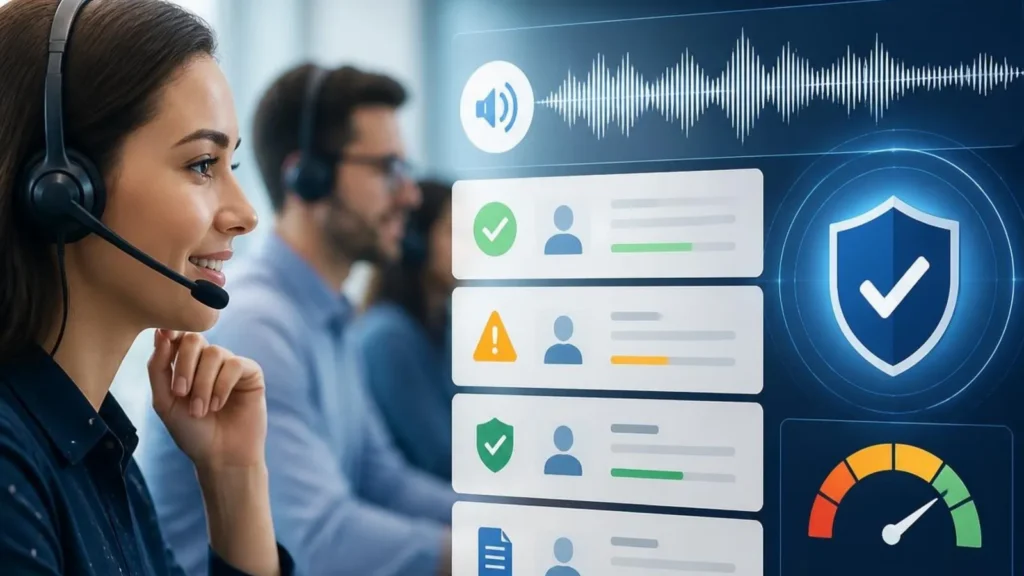
Automated QA is one of the most important tools for contact center compliance monitoring. Instead of reviewing only a small sample of calls, automated QA can help evaluate interactions more consistently across a larger set of conversations.
AgentAssist.com Automated QA platform supports customized automated scorecards, multiple scorecards per call or agent, scoring rationale, automated scoring and reporting, and quality monitoring workflows. This helps teams evaluate calls against the criteria that matter to the business.
For compliance monitoring, scorecards may be designed around required steps or review categories such as disclosure language, identity verification, complaint handling, documentation, escalation procedure, sensitive information handling, or follow-up commitments.
The value is not only in scoring. The value is in creating a repeatable system. When every reviewer uses the same criteria, it becomes easier to compare performance, find recurring gaps, and coach agents with more clarity.
Compliance Monitoring Is Not Just About Catching Mistakes
A strong compliance monitoring program should not be built only around finding errors. It should also help improve processes.
If one agent misses a required step, that may be a coaching issue. If many agents miss the same step, the issue may be the workflow. The script may be unclear. The knowledge base may be outdated. The process may be difficult to follow. The customer may be asking questions that create confusion.
This is why compliance monitoring should connect to reporting and operational review. The goal is not just to identify individual calls. The goal is to understand why certain issues happen and how to reduce them over time.
AgentAssist.com Analytics and Conversation Analytics tools can support this by helping teams review trends, search conversations, apply filters, create reports, and identify patterns in customer interactions.
How Case Management Supports Compliance Review
Some compliance-sensitive conversations need more than a QA score. They need review, notes, follow-up, escalation, or classification as a non-issue.
That is where case management becomes important.
AgentAssist.com Case Management solution helps teams create customized cases, receive alerts, review flagged calls, add notes, classify non-issues, escalate concerns, and generate customized reports. This supports compliance monitoring by giving teams a workflow for conversations that may need closer attention.
For example, a call may be flagged because it includes complaint language, a required procedure concern, sensitive account information, or a customer statement that needs review. A compliance reviewer can inspect the call, add notes, decide whether action is needed, and escalate if appropriate.
This keeps compliance review from becoming a disconnected spreadsheet or inbox task. It becomes part of a structured workflow.
How Conversation Analytics Helps Compliance Teams
Conversation analytics helps compliance teams find and understand relevant interactions faster. Instead of relying only on random samples, teams can search for specific topics, phrases, classifications, or patterns.
AgentAssist.com Conversation Analytics platform supports filters, saved searches, call review, insight extraction, reports, and redaction of PII and sensitive data. These features can help teams review conversations more efficiently and protect sensitive information during analysis.
For compliance teams, conversation analytics can help answer questions such as:
- Are required topics being handled consistently?
- Are complaint-related calls increasing?
- Are certain policies creating confusion?
- Are specific teams seeing more compliance-sensitive conversations?
- Are calls involving sensitive information being handled properly?
- Are certain issues creating repeat customer contact?
These questions help teams move beyond one-call review and look at compliance patterns across the contact center.
How Call Classification Helps Identify Compliance-Sensitive Calls
Call classification helps contact centers organize conversations by reason, intent, topic, or issue type. This can support compliance monitoring by making it easier to identify categories of calls that may need closer review.
For example, a contact center may want to classify and review calls involving:
- Complaints
- Account verification
- Payment issues
- Cancellation concerns
- Required disclosures
- Sensitive information
- Fraud-risk conversations
- Policy questions
- Escalation requests
AgentAssist.com Call Classification solution helps businesses understand why customers are contacting them, listen to calls by classification, and track intent trends. This can help compliance teams focus on the categories that matter most.
The goal is not to treat every classified call as a problem. The goal is to create a better way to find and review conversations that may carry higher risk.
How Compliance Monitoring Supports Agent Coaching
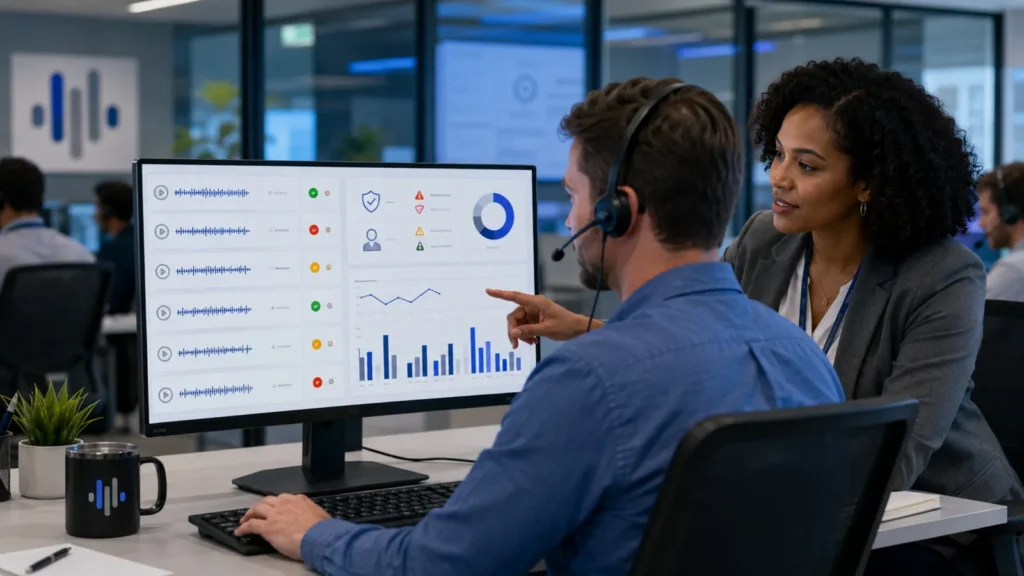
Compliance monitoring should lead to better coaching. When agents need support, supervisors should be able to show where the issue happened and what the correct process should look like.
AgentAssist.com Agent Coaching platform supports coaching workflows through tasks, notes, timestamps, alerts, and reporting. This helps supervisors turn compliance findings into practical agent development.
For example, if a call review shows that an agent missed a required explanation, the supervisor can create a coaching task tied to the relevant moment. If several agents struggle with the same requirement, leadership may need to update training, scripts, or knowledge base content.
Coaching works best when it is specific. “Improve compliance” is too broad. “Follow the required verification step before discussing account details” is clearer and easier to act on.
How Real-Time Assist Can Support Compliance Workflows
Real-Time Assist can support compliance workflows by helping agents stay aligned with required steps during live conversations. This may include contextual prompts, checklist-style guidance, or reminders related to selected workflows.
For example, if an agent is handling an account verification call, a real-time workflow may help remind them of the required process. If the conversation involves a cancellation concern, the agent may need guidance around the correct next step. If a customer raises a complaint, the agent may need support following the right documentation or escalation workflow.
Real-time guidance can help support agent consistency, but it should not be treated as guaranteeing perfect compliance.
AgentAssist.com Real-Time Assist platform supports contextual in-conversation guidance designed to help agents follow workflows and respond more effectively during live calls.
Common Compliance Monitoring Mistakes
Contact centers often make compliance monitoring harder than it needs to be. One common mistake is relying too heavily on random sampling. Random sampling can still be useful, but it may miss the conversations that most need review.
Another mistake is using unclear scorecards. If reviewers do not understand the criteria, scoring becomes inconsistent. If agents do not understand the expectations, coaching becomes frustrating.
A third mistake is separating compliance review from operations. Compliance findings should not sit in isolation. They should connect to coaching, QA, process updates, knowledge base improvements, and leadership reporting.
The strongest compliance monitoring systems are practical, reviewable, and connected to action.
What to Look for in Contact Center Compliance Monitoring Software
Contact center leaders should look for software that supports both review and action. A platform should make it easier to identify relevant conversations, evaluate them consistently, document findings, escalate concerns, and improve workflows.
Important capabilities include:
- Automated QA scorecards
- Custom review criteria
- Required language monitoring
- Conversation search
- Call classification
- Case management workflows
- Notes and follow-up actions
- Alerts and notifications
- Coaching workflows
- Custom reports and dashboards
- PII and sensitive data redaction
- Secure handling of customer information
AgentAssist.com fits this model because compliance monitoring can connect across Automated QA, Case Management, Conversation Analytics, Call Classification, Agent Coaching, Call Summarization, Real-Time Assist, and Analytics.
That connection matters. Compliance monitoring is most useful when findings lead to review, coaching, escalation, and improvement.
How AgentAssist.com Helps Contact Centers Monitor Compliance Risk
AgentAssist.com helps contact centers build more structured compliance monitoring workflows. Automated QA can help teams evaluate interactions through custom scorecards and reporting. Case Management can help organize flagged calls, notes, alerts, and escalation workflows. Conversation Analytics can help teams search, filter, review, and report on conversations. Agent Coaching can help supervisors turn findings into targeted coaching.
Together, these capabilities help contact centers review more relevant conversations, improve consistency, and identify trends that may require action.
The right way to describe the value is simple: AgentAssist.com helps contact centers reduce compliance risk by improving visibility, review workflows, and operational follow-up.
Final Thoughts
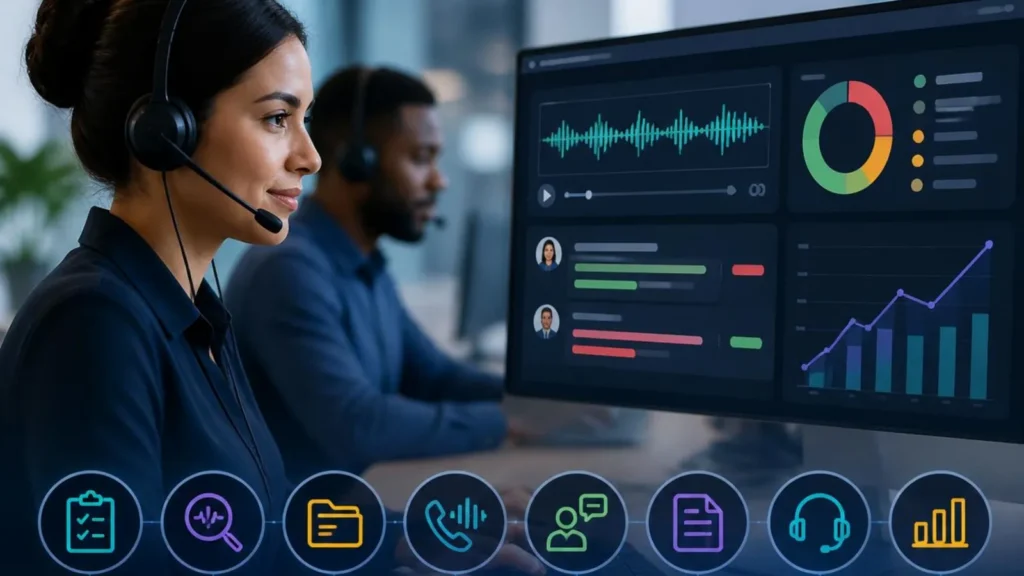
Contact center compliance monitoring is not just about checking boxes. It is about creating a reliable system for reviewing conversations, identifying risk-sensitive topics, supporting agents, documenting findings, and improving workflows.
Manual review alone can leave gaps. AI-supported monitoring can help teams evaluate more conversations, flag calls for review, apply consistent criteria, connect findings to coaching, and track trends over time.
AgentAssist.com helps contact centers connect compliance monitoring with Automated QA, Case Management, Conversation Analytics, Call Classification, Agent Coaching, Call Summarization, Real-Time Assist, and Analytics. That gives supervisors, QA leaders, compliance teams, and operations managers a stronger way to review important interactions and reduce risk.
Contact center compliance monitoring is the process of reviewing customer conversations to help determine whether agents followed required procedures, used required language, handled sensitive topics properly, and documented interactions correctly.
AI can help contact centers review conversations using selected criteria such as keywords, required language, call classifications, metadata, and QA scorecards. Human review is still important for context and final decisions.
No. AI compliance monitoring should not be described as guaranteeing compliance. It can help reduce compliance risk by improving visibility, review consistency, and follow-up workflows.
Automated QA can help evaluate interactions against custom scorecards, required procedures, disclosure language, documentation steps, and other review criteria.
Case management helps teams organize flagged calls, add notes, classify cases, escalate concerns, send alerts, and track outcomes.
AgentAssist.com supports compliance monitoring through Automated QA, Case Management, Conversation Analytics, Call Classification, Agent Coaching, Call Summarization, Real-Time Assist, and Analytics.
Ready to improve compliance visibility across customer conversations?
See how AgentAssist.com helps contact centers review important calls, apply consistent QA workflows, flag compliance-sensitive topics, and turn findings into action. Book a demo today.
Sources Used
- AgentAssist.com — Automated QA
https://agentassist.com/platform/automated-qa/ - AgentAssist.com — Case Management
https://agentassist.com/platform/case-management/ - AgentAssist.com — Conversation Analytics
https://agentassist.com/platform/conversation-analytics/ - AgentAssist.com — Call Classification
https://agentassist.com/platform/call-classification/ - AgentAssist.com — Agent Coaching
https://agentassist.com/platform/agent-coaching/ - AgentAssist.com — Call Summarization
https://agentassist.com/platform/call-summarization/ - AgentAssist.com — Real-Time Assist
https://agentassist.com/platform/real-time-assist/ - AgentAssist.com — Analytics
https://agentassist.com/platform/analytics/ - AgentAssist.com — Homepage
https://agentassist.com/ - Google Search Central — Search Essentials
https://developers.google.com/search/docs/essentials - Google Search Central — Creating Helpful, Reliable, People-First Content
https://developers.google.com/search/docs/fundamentals/creating-helpful-content