
Key Takeaways
- High-risk call review helps contact centers identify conversations that may need supervisor, QA, compliance, or operations review.
- A high-risk call may involve complaints, escalations, service failures, fraud-risk indicators, compliance-sensitive topics, or repeated unresolved issues.
- Flagged calls should move into a clear review workflow, not sit inside a disconnected report.
- Contact centers should use selected criteria such as keywords, metadata, call classifications, issue types, and business rules to decide what gets reviewed.
- AgentAssist.com helps contact centers connect high-risk call review with Case Management, Conversation Analytics, Call Classification, Automated QA, Agent Coaching, Call Summarization, Real-Time Assist, and Analytics.
Estimated reading time: 13 minutes
Table of contents
- What Is High-Risk Call Review?
- Why High-Risk Calls Are Easy to Miss
- What Makes a Call High Risk?
- The Difference Between Flagging a Call and Solving the Issue
- How Contact Centers Can Flag High-Risk Calls
- Why Criteria Matter
- How Conversation Analytics Supports High-Risk Call Review
- How Call Classification Supports High-Risk Call Review
- How Case Management Turns Flagged Calls Into Action
- How High-Risk Call Review Supports Automated QA
- How High-Risk Call Review Improves Coaching
- A Practical Example
- What Contact Centers Should Avoid
- What to Look for in High-Risk Call Review Software
- How AgentAssist.com Helps Contact Centers Review High-Risk Calls
- Final Thoughts
- Key Takeaways
Some customer conversations are routine. Others need a closer look.
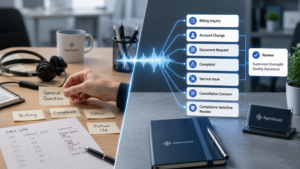
A customer may mention a formal complaint, ask for a supervisor, reference a previous unresolved issue, discuss sensitive account information, raise a billing dispute, or use language that suggests a compliance-sensitive concern. These conversations may not always be obvious in a large contact center operation, especially when supervisors and QA teams are reviewing only a small portion of interactions.
High-risk call review gives contact centers a better way to identify important conversations and move them into a structured review process. The goal is not to assume every flagged call is a problem. The goal is to help the right people review the right conversations faster.
AgentAssist.com supports this type of workflow through Case Management, Conversation Analytics, Call Classification, Automated QA, Analytics, and related contact center AI tools. Its Case Management solution helps teams create customized cases, receive alerts, review flagged calls, add notes, classify non-issues, escalate concerns, and generate reports.
What Is High-Risk Call Review?
High-risk call review is the process of identifying and reviewing customer conversations that may need additional attention. These calls may involve customer dissatisfaction, sensitive topics, escalation language, compliance-risk indicators, service problems, or other business concerns.
The phrase “high-risk” does not mean the customer is wrong, the agent made a mistake, or the company has a confirmed issue. It simply means the call contains signals that may deserve closer review.
For example, a customer calling to update an address may be routine. But if that same call includes identity verification concerns, repeated failed attempts, a complaint about a prior interaction, or language related to unauthorized activity, the conversation may need review.
High-risk call review helps contact centers answer an important question: which conversations should supervisors, QA leaders, or compliance teams look at first?
Why High-Risk Calls Are Easy to Miss
In a busy contact center, important calls can hide inside normal call volume. A supervisor may only hear about an issue if the agent escalates it. A QA team may only catch the call if it appears in a sample. A compliance reviewer may not see the conversation unless it is manually reported.
That creates a visibility problem.
A call may include a customer complaint, but the final disposition may say “resolved.” A customer may mention that they have called three times, but the note may only say “billing question.” A sensitive topic may come up briefly in the middle of a long conversation and never appear in the summary. A supervisor request may be handled calmly, but still need documentation or follow-up.
When high-risk calls are missed, the contact center loses an opportunity to act early. The issue may become a repeat call, a complaint, a poor customer experience, or a process problem that continues across many interactions.
What Makes a Call High Risk?
A call may be considered high risk when it includes language, topics, metadata, or patterns that suggest the conversation needs closer review. The exact definition should depend on the company’s industry, policies, workflows, and customer expectations.
In contact center operations, high-risk call categories often include:
- Customer escalation requests
- Complaint-related language
- Repeated unresolved issues
- Billing disputes
- Service failures
- Fraud-risk conversations
- Compliance-sensitive topics
- Required procedure concerns
- Sensitive customer information
- Unauthorized activity concerns
- Cancellation concerns
- Supervisor requests
These categories should be treated as review signals, not automatic conclusions. A flagged call may turn out to be a non-issue after review. That is why the review process matters.
AgentAssist.com Case Management solution supports this type of workflow by helping teams identify calls based on selected criteria, review flagged calls, classify non-issues, escalate real concerns, add notes, and send alerts to key team members.
The Difference Between Flagging a Call and Solving the Issue
Flagging a call is only the first step. The real value comes from what happens next.
A contact center can have many flagged calls and still struggle if there is no clear workflow for review, classification, notes, escalation, follow-up, and reporting. A flag tells the team, “This conversation may need attention.” It does not automatically decide the outcome.
That distinction is important for compliance, QA, and operations teams. AI-supported workflows can help identify calls for review, but human oversight still matters. Supervisors and subject matter experts need to evaluate context, determine whether the issue is real, and decide what action should follow.
A strong high-risk call review process has three layers.
First, the call is identified through selected criteria. Second, the call is reviewed by the right person. Third, the result is documented and used to improve the business.
Without the second and third layers, call flagging becomes just another report.
How Contact Centers Can Flag High-Risk Calls
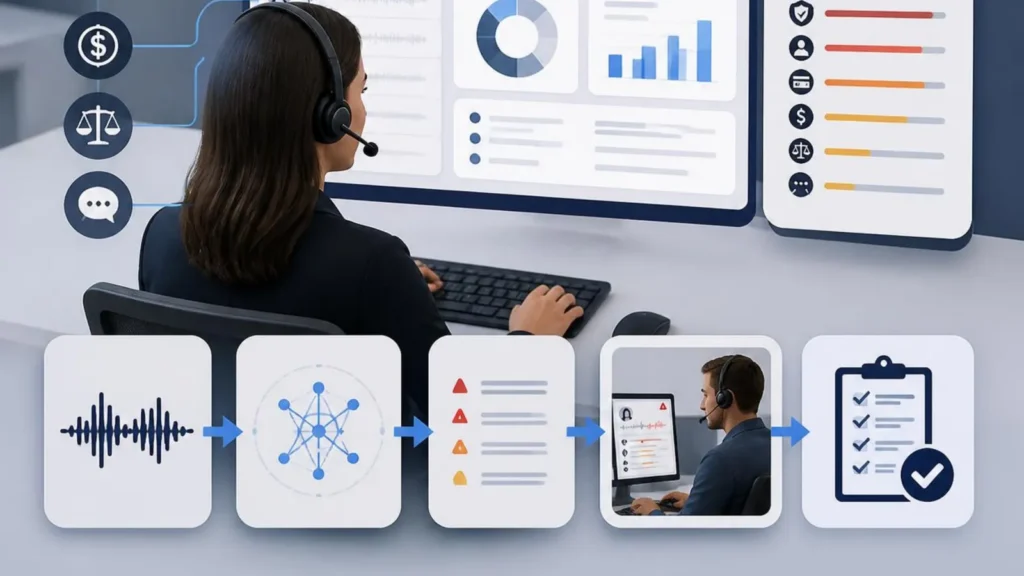
High-risk calls can be flagged using a combination of keywords, call classifications, metadata, and business rules. A contact center may choose to flag conversations when customers mention certain topics, when a call falls into a specific category, when a call exceeds a certain duration, or when a customer uses escalation-related language.
A practical review workflow may look like this:
- The contact center defines which call types need closer review.
- Calls are analyzed using selected criteria such as keywords, metadata, topics, call classifications, or intent categories.
- Matching calls are flagged for review.
- Supervisors, QA leaders, compliance reviewers, or operations teams review the flagged conversations.
- Reviewers decide whether the call is a non-issue, coaching opportunity, escalation, compliance-risk concern, or process improvement signal.
- Notes and follow-up actions are added.
- Reports help leaders track patterns, outcomes, and recurring issues.
This gives the contact center a repeatable system. Instead of depending only on memory or manual discovery, teams can work from a more organized review queue.
Why Criteria Matter
The quality of a high-risk call review workflow depends on the quality of its criteria.
If the criteria are too broad, supervisors may receive too many false positives. If the criteria are too narrow, important calls may be missed. If the categories are unclear, reviewers may not know what action to take.
A good starting point is to define risk by business need. For one contact center, high-risk may mean formal complaint language. For another, it may mean fraud-risk indicators. For another, it may mean calls where agents must follow a required procedure.
Contact centers should avoid building criteria around vague ideas like “bad call” or “upset customer.” Those labels are too subjective. Better criteria are tied to specific language, topics, workflows, classifications, or review requirements.
For example, instead of flagging “negative tone,” a safer and clearer rule may focus on complaint keywords, supervisor requests, cancellation language, unresolved issue references, or specific policy-related phrases. This keeps the review process more grounded and easier to validate.
How Conversation Analytics Supports High-Risk Call Review
Conversation analytics gives contact centers the ability to search, filter, review, and report on customer interactions. This is especially useful for high-risk call review because teams often need to find patterns across many conversations.
AgentAssist.com Conversation Analytics platform supports more than 20 filters, saved searches, call review, insight extraction, PII and sensitive data redaction, and customized reports.
For high-risk call review, conversation analytics can help teams answer questions like:
- Are complaint-related calls increasing?
- Are certain teams or queues seeing more escalation language?
- Are customers mentioning the same unresolved issue?
- Are specific products, policies, or workflows creating repeat concerns?
- Are calls involving sensitive topics being reviewed consistently?
- Are certain call classifications tied to more cases?
These questions are more useful than simply asking how many calls came in. They help leaders understand where attention is needed.
How Call Classification Supports High-Risk Call Review
Call classification helps organize conversations by reason, intent, topic, or issue type. This matters because high-risk calls often become easier to identify when the contact center already understands why customers are calling.
AgentAssist.com Call Classification solution is designed to help teams understand why customers are contacting them, create customizable intent structures, listen to calls by classification, and track intent trends.
For example, a contact center may classify calls by categories such as billing dispute, cancellation concern, account verification, service issue, supervisor request, or complaint follow-up. From there, leadership can decide which categories should be reviewed more closely.
This is more useful than treating every call the same. A routine account update may not need supervisor review. A repeated billing dispute with escalation language may need to become a case.
Call classification helps separate normal operating volume from conversations that may deserve attention.
How Case Management Turns Flagged Calls Into Action
Case management is where high-risk call review becomes operational.
A flagged call should not simply appear in a dashboard. It should move into a workflow where someone can review it, add notes, classify the outcome, and take the next step.
AgentAssist.com Case Management solution supports customized case generation, quick review and classification, notes, alerts, notifications, and customized reports.
A practical case review process might include a supervisor reviewing the call, marking it as a non-issue when appropriate, escalating it if action is needed, adding notes for context, notifying a compliance or operations leader, and tracking the outcome in a report.
This creates accountability. It also helps the contact center learn from its own conversations.
If many flagged calls turn out to be non-issues, the criteria may need refinement. If many flagged calls reveal the same problem, the business may need a process change, training update, script improvement, or customer communication fix.
How High-Risk Call Review Supports Automated QA
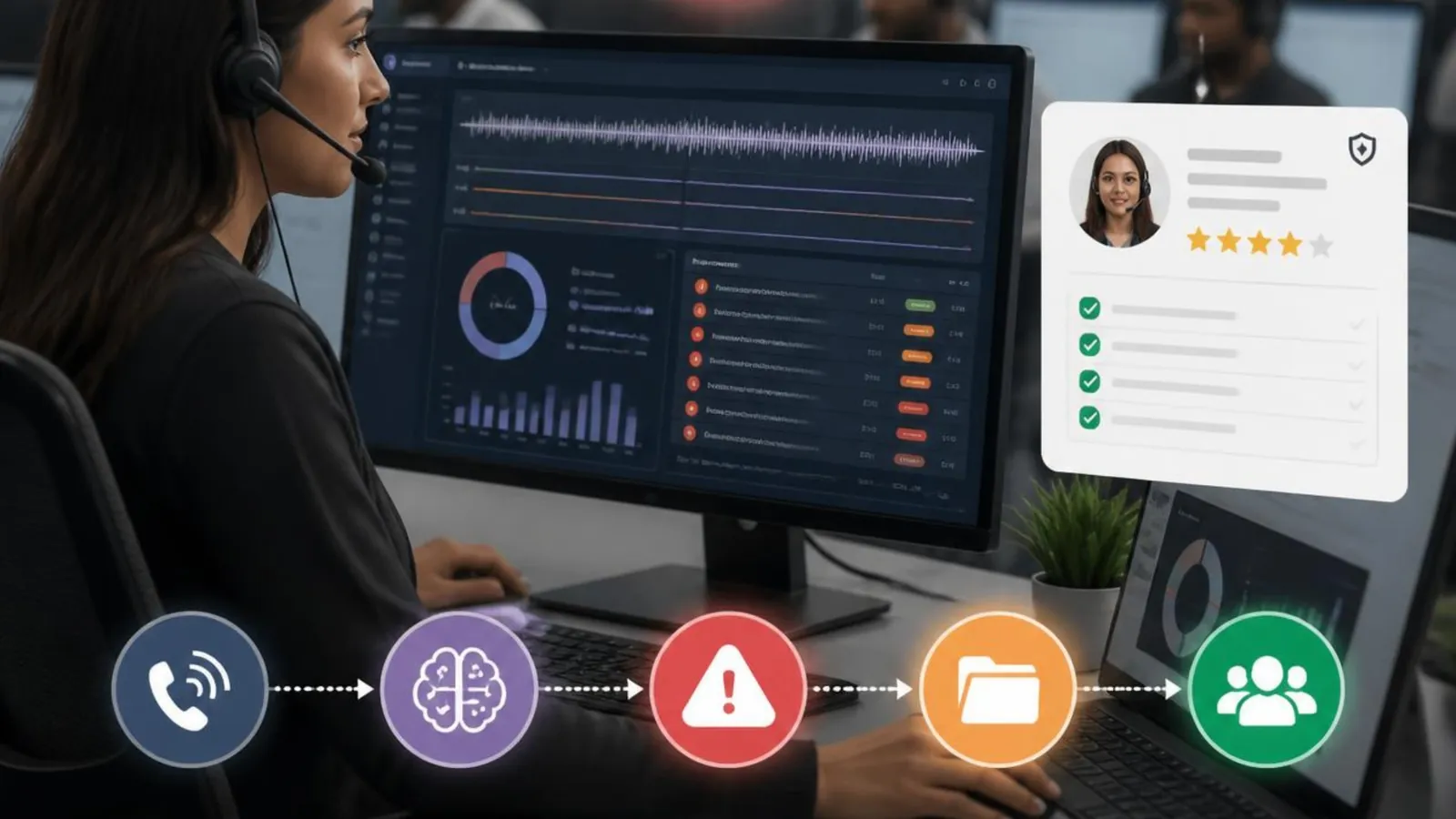
High-risk call review and automated QA can work together.
Automated QA helps contact centers evaluate interactions more consistently across a larger set of conversations. AgentAssist.com Automated QA platform supports customized scorecards, multiple scorecards per call or agent, scoring rationale, and reporting.
High-risk call review can help QA teams prioritize where to look. Instead of only reviewing random samples, QA leaders can focus on calls that match important categories or selected criteria.
For example, QA may want to review flagged calls involving required disclosures, complaint language, escalation requests, account verification, or service failure concerns. These calls may provide more useful insight than a random sample alone.
This does not mean random QA has no value. It means targeted review can add another layer of intelligence.
How High-Risk Call Review Improves Coaching
Flagged calls can also reveal coaching opportunities.
A flagged call may show that an agent needs help with escalation language, procedure steps, documentation, policy explanation, or customer handoff. It may also show that the agent handled a difficult interaction well and should be recognized.
The coaching value comes from context. Instead of saying, “Improve escalation handling,” a supervisor can point to the specific moment in the call where the agent needed a better next step.
High-risk call review can also reveal when coaching is not the answer. If multiple agents struggle with the same type of call, the problem may be the workflow, not the individual. The business may need clearer policy language, better knowledge base content, improved customer communication, or updated call guidance.
This is where high-risk call review becomes more than a quality control process. It becomes a learning system.
A Practical Example
Imagine a contact center notices an increase in calls involving account verification. Most calls are routine, but some include customers saying they have already submitted documents, already called twice, or were told different instructions by different agents.
If those conversations are not flagged, the issue may look like normal call volume. But if they are identified and reviewed, the pattern becomes clearer.
The team may discover that customers are confused by document instructions. QA may find that agents are explaining the process inconsistently. Supervisors may create coaching tasks for specific agents. Operations may update customer emails or self-service instructions. Leaders may use analytics to track whether the issue decreases after changes are made.
That is the power of high-risk call review. It turns individual conversations into operational insight.
What Contact Centers Should Avoid
High-risk call review should be focused, not overwhelming.
Contact centers should avoid flagging every difficult call, every long call, or every call with one broad keyword. That can create review fatigue. Supervisors may start ignoring alerts if too many calls are flagged without clear value.
Teams should also avoid treating flagged calls as confirmed violations or confirmed service failures. A flag means “review this.” It does not mean “this is definitely a problem.”
A strong review process should make room for context, human judgment, and continuous refinement.
What to Look for in High-Risk Call Review Software
Contact center leaders should look for software that helps identify calls, organize review, document outcomes, and report on trends.
Important capabilities include:
- Custom case criteria
- Keyword and metadata-based flagging
- Call classification support
- Conversation search and filters
- Saved searches
- Case review queues
- Notes and follow-up actions
- Alerts and notifications
- Automated QA connection
- Custom reports and dashboards
- Secure handling of sensitive information
The most important point is connection. High-risk call review should connect to analytics, QA, case management, coaching, and reporting. Otherwise, teams may collect more signals without improving the workflow.
AgentAssist.com supports this connected approach through Case Management, Conversation Analytics, Call Classification, Automated QA, Agent Coaching, Call Summarization, Real-Time Assist, and Analytics.
How AgentAssist.com Helps Contact Centers Review High-Risk Calls
AgentAssist.com helps contact centers create a more structured process for identifying and reviewing important conversations.
Its Case Management solution can help teams receive alerts for customized cases, review flagged calls, classify non-issues, escalate concerns, add notes, notify key team members, and generate customized reports. Its Conversation Analytics platform can help teams search, filter, review, and report on conversations. Its Call Classification solution can help identify call reasons and intent trends.
Together, these tools help contact centers move from scattered review to organized action.
Instead of depending only on manual escalation, random sampling, or after-the-fact complaints, teams can create a more intentional review workflow around the conversations that matter most.
Final Thoughts
High-risk call review helps contact centers identify customer conversations that may need closer attention. These calls may involve complaints, escalations, compliance-sensitive topics, service failures, fraud-risk indicators, procedure concerns, or repeated unresolved issues.
The goal is not to overstate what AI can do. The goal is to help teams review important calls faster, document context, escalate real concerns, and improve the workflows behind customer experience.
AgentAssist.com helps contact centers connect high-risk call review with Case Management, Conversation Analytics, Call Classification, Automated QA, Agent Coaching, Call Summarization, Real-Time Assist, and Analytics. That gives supervisors, QA teams, compliance reviewers, and operations leaders a better way to find the right conversations and act on them.
Key Takeaways
- High-risk call review helps contact centers identify conversations that may need supervisor, QA, compliance, or operations review.
- A high-risk call may involve complaints, escalations, service failures, fraud-risk indicators, compliance-sensitive topics, or repeated unresolved issues.
- Flagged calls should move into a clear review workflow, not sit inside a disconnected report.
- Contact centers should use selected criteria such as keywords, metadata, call classifications, issue types, and business rules to decide what gets reviewed.
- AgentAssist.com helps contact centers connect high-risk call review with Case Management, Conversation Analytics, Call Classification, Automated QA, Agent Coaching, Call Summarization, Real-Time Assist, and Analytics.