Key Takeaways
- A QA scorecard for contact centers provides structured evaluations of customer interactions, measuring key aspects like communication quality and process adherence.
- Effective scorecards focus on specific criteria that guide agent coaching rather than merely producing a score.
- Automated QA improves consistency in scorecard application across interactions, allowing for better performance monitoring.
- AgentAssist.com enhances QA workflows by integrating automated scoring, reporting, and coaching for comprehensive performance improvement.
- Contact centers should tailor scorecards to reflect their unique business goals, ensuring they connect QA findings to actionable coaching.
Estimated reading time: 15 minutes
Table of contents
- What Is a QA Scorecard for Contact Centers?
- Why Many QA Scorecards Fall Short
- Start With the Purpose of the Scorecard
- Core Categories to Include in a Contact Center QA Scorecard
- Make Scorecard Criteria Specific
- Use Different Scorecards for Different Call Types
- Balance Scores With Rationale
- Connect QA Scorecards to Coaching
- Connect QA Scorecards to Conversation Analytics
- Use QA Scorecards to Identify Process Problems
- How Automated QA Improves Scorecard Consistency
- How to Calibrate QA Scorecards
- Do Not Overweight the Wrong Behaviors
- How QA Scorecards Support Reporting
- Common QA Scorecard Mistakes
- What to Look for in Automated QA Scorecard Software
- How AgentAssist.com Helps Contact Centers Build Better QA Scorecards
- Final Thoughts
- Key Takeaways
- Ready to build QA scorecards that lead to better coaching?
A QA scorecard for contact centers helps quality teams evaluate customer interactions with more structure, consistency, and purpose. Instead of relying on general opinions about whether a call was “good” or “bad,” a scorecard gives reviewers a clear framework for measuring what matters.
That framework may include greeting quality, customer verification, problem identification, policy adherence, required disclosures, resolution quality, documentation, escalation handling, and next-step clarity. A strong QA scorecard helps contact centers evaluate agent performance, identify coaching needs, improve customer experience, and reduce operational risk.
But many contact center scorecards are too vague, too long, or disconnected from real customer conversations. They may measure agent behavior without considering call type, customer intent, escalation risk, or workflow complexity. They may produce a score without helping supervisors understand what to do next.
AgentAssist.com supports better QA workflows through Automated QA, Agent Coaching, Analytics, Conversation Analytics, Call Classification, Case Management, Call Summarization, and Real-Time Assist. Its Automated QA platform supports customized scorecards, multiple scorecards per call or agent, scoring rationale, and reporting. That makes QA scorecards more than a review form. They become part of a larger performance improvement system.
What Is a QA Scorecard for Contact Centers?

A QA scorecard is a structured evaluation tool used to review customer interactions. In a contact center, QA scorecards help reviewers evaluate whether agents followed the right process, communicated clearly, handled the customer’s issue, documented the interaction, and met internal quality standards.
A basic scorecard may include a list of questions with points assigned to each category. A more advanced scorecard may include different scoring sections based on call type, customer intent, risk level, department, product line, or workflow.
The purpose of a QA scorecard is not just to grade agents. The purpose is to create consistent evaluation, identify patterns, and support better coaching.
A scorecard should help answer three questions.
Did the agent follow the right process?
Did the customer receive clear and accurate support?
What should the team improve next?
Why Many QA Scorecards Fall Short
Many contact centers already use QA scorecards, but not all scorecards help managers make better decisions.
Some scorecards are too generic. They ask broad questions like “Was the agent professional?” or “Did the agent resolve the issue?” Those questions may be useful, but they do not always give supervisors enough detail for coaching.
Other scorecards are too complicated. They include too many categories, too many point values, or too many edge cases. Reviewers may spend more time interpreting the scorecard than evaluating the call.
Some scorecards are outdated. They may reflect old processes, old scripts, or old business priorities. If the scorecard does not match the current customer experience, QA results become less useful.
The biggest issue is that many QA scorecards are disconnected from action. They produce a number, but they do not clearly show what the supervisor should coach, what the agent should change, or what process needs improvement.
A better scorecard should lead to better decisions.
Start With the Purpose of the Scorecard
Before building a QA scorecard, contact center leaders should define what the scorecard is meant to improve.
A scorecard for compliance-sensitive calls may look different from a scorecard for sales calls, billing support, technical support, onboarding, retention, or complaint handling.
The scorecard should reflect the business goal.
If the goal is better customer experience, the scorecard should measure clarity, empathy, issue understanding, next-step communication, and resolution quality.
If the goal is risk reduction, the scorecard should measure required language, identity verification, documentation, escalation procedure, and sensitive information handling.
If the goal is agent coaching, the scorecard should highlight behaviors that supervisors can coach.
If the goal is process improvement, the scorecard should help identify where agents and customers are getting stuck.
A scorecard without a clear purpose often becomes a checklist. A scorecard with a clear purpose becomes a management tool.
Core Categories to Include in a Contact Center QA Scorecard

Every contact center will need different scorecard categories, but most strong QA scorecards include a mix of customer experience, process, accuracy, and documentation criteria.
Common categories include:
- Opening and greeting
- Customer verification
- Issue identification
- Active listening
- Accuracy of information
- Policy or procedure adherence
- Required disclosure language
- Resolution quality
- Escalation handling
- Documentation quality
- Follow-up clarity
- Closing and next steps
These categories should not be added just because they are common. They should be included because they support the contact center’s real goals.
For example, a healthcare support team may place more weight on verification and sensitive information handling. A financial services team may place more weight on disclosures, account access, complaint handling, and documentation. A software support team may focus more on issue diagnosis, troubleshooting steps, and resolution accuracy.
The best scorecard reflects the actual call environment.
Make Scorecard Criteria Specific
Specific criteria make QA scoring more consistent.
A vague question such as “Did the agent communicate well?” can be interpreted in many ways. One reviewer may focus on tone. Another may focus on clarity. Another may focus on whether the agent interrupted the customer.
A better question is more specific.
For example:
“Did the agent clearly confirm the customer’s issue before offering a solution?”
That question is easier to evaluate. It also gives supervisors a clearer coaching point.
Specific scorecard criteria should be:
- Easy for reviewers to understand
- Tied to observable behavior
- Relevant to the call type
- Connected to business priorities
- Useful for coaching
- Clear enough for agents to learn from
When scorecard questions are specific, scoring becomes more consistent and feedback becomes more actionable.
Use Different Scorecards for Different Call Types
One scorecard rarely fits every conversation.
A billing dispute, account update, cancellation concern, technical support call, complaint call, and compliance-sensitive conversation may each require different evaluation criteria.
AgentAssist.com Automated QA platform supports applying multiple scorecards to each call or agent. This matters because different interactions should be evaluated in ways that match the customer’s intent and the business workflow.
For example, a cancellation call may need a scorecard that reviews retention process, required language, escalation handling, and documentation. A billing call may need a scorecard that reviews account explanation, policy accuracy, payment guidance, and follow-up clarity. A complaint call may need a scorecard that reviews issue acknowledgment, documentation, escalation procedure, and next steps.
When the right scorecard is applied to the right interaction, QA becomes more accurate.
Balance Scores With Rationale
A score alone does not always explain what happened.
If an agent receives an 82%, they need to know why. Did they miss a required step? Did they give incomplete information? Did they fail to document the follow-up? Did the customer’s issue require a different workflow? Did the reviewer interpret the criteria correctly?
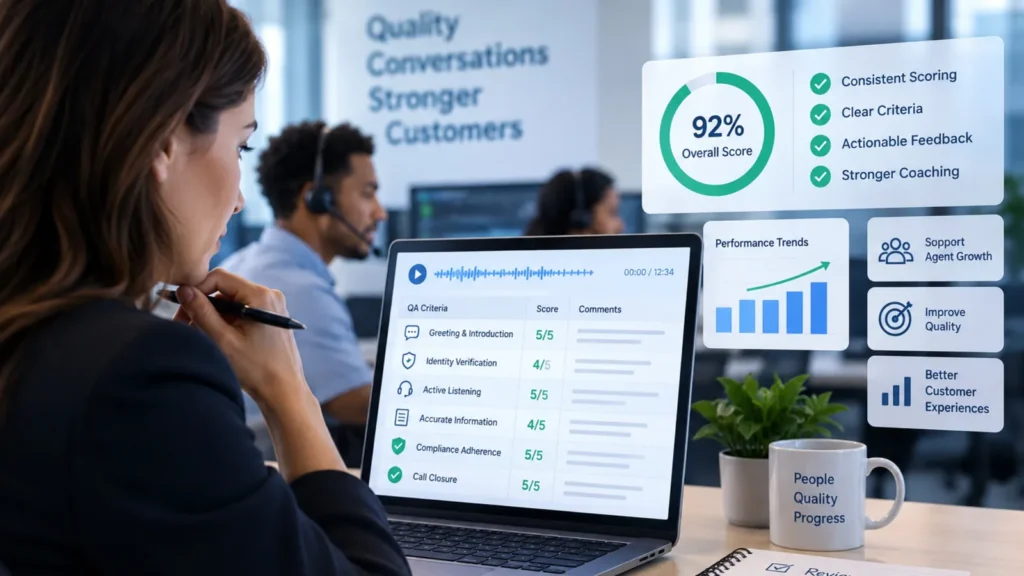
AgentAssist.com Automated QA platform supports scorecards that provide the score as well as scoring rationale. This is important because rationale turns a score into feedback.
A good QA process should explain the reason behind the score. That helps agents understand what to improve and helps supervisors coach with more clarity.
Without rationale, QA can feel arbitrary. With rationale, QA becomes easier to trust.
Connect QA Scorecards to Coaching

QA scorecards are most valuable when they lead to coaching.
If QA identifies a missed step, unclear explanation, documentation issue, or escalation concern, the next step should not be limited to recording the score. The finding should connect to a coaching workflow.
AgentAssist.com Agent Coaching platform supports 1:1 coaching, tasks, notes, timestamps, alerts, agent portals, and tracking/reporting. This helps supervisors move from scorecard results to practical coaching actions.
For example, a QA scorecard may show that an agent struggles with required verification language. The supervisor can create a coaching task, attach notes, reference the relevant moment in the call, and track completion.
That is more useful than simply telling the agent to improve.
A strong QA-to-coaching workflow helps answer:
- What happened?
- Why did it affect the score?
- What should the agent do differently next time?
- Has coaching been assigned?
- Has the agent completed the coaching task?
- Did performance improve after coaching?
Connect QA Scorecards to Conversation Analytics
Conversation analytics helps QA teams understand patterns across calls.
A single low score may be an isolated issue. A repeated scorecard failure across many calls may reveal a training issue, process issue, or customer communication problem.
AgentAssist.com Conversation Analytics platform supports filters, saved searches, call review, insight extraction, and customized reports. This helps QA teams review calls by topic, classification, agent, queue, or other criteria.
For example, QA leaders may discover that agents perform well on routine account updates but struggle with billing disputes. Or they may find that required disclosure issues appear mostly in one call category. Or they may see that a certain workflow creates repeated documentation problems.
This helps QA move beyond individual scoring and into operational improvement.
Use QA Scorecards to Identify Process Problems
A QA scorecard should not only evaluate agents. It should also reveal where the business process is weak.
If many agents miss the same step, the issue may not be agent effort. The process may be confusing, the script may be unclear, the knowledge base may be outdated, or customers may be asking questions the current workflow does not handle well.
This is where contact center leaders need to be careful. QA should not automatically blame the agent for every scorecard gap.
A good QA program asks whether the problem is individual, team-wide, process-related, or customer-experience-related.
For example, if agents frequently struggle to explain a policy, the policy explanation may need to be rewritten. If customers frequently call back after a certain process, the handoff may be weak. If documentation is often incomplete after complex calls, agents may need better summary support or clearer wrap-up requirements.
QA scorecards can reveal those patterns if leaders look beyond the score.
How Automated QA Improves Scorecard Consistency
Manual QA review can be helpful, but it has limitations. Human reviewers may interpret criteria differently, review only a small sample, or focus on different details from one call to the next.
Automated QA can help create more consistent evaluation across more interactions. AgentAssist.com Automated QA platform is designed to analyze interactions with customized scorecards and reporting, helping teams monitor policies, procedures, productivity, compliance, and more.
This does not remove the need for human judgment. Supervisors, QA leaders, and compliance reviewers still need to interpret context, review edge cases, and refine criteria.
The best approach is to use automated QA for scale and consistency, then use human review for context, calibration, coaching, and decision-making.
How to Calibrate QA Scorecards

QA calibration is the process of making sure reviewers score calls consistently. Even with a good scorecard, different reviewers may interpret criteria differently.
Calibration helps align expectations.
A simple calibration process may include:
- Select a small group of calls for review.
- Have multiple reviewers score the same calls.
- Compare scoring differences.
- Discuss why reviewers interpreted criteria differently.
- Clarify or rewrite confusing scorecard questions.
- Update reviewer guidance.
- Repeat calibration regularly.
Calibration is especially important when new scorecards are created, new reviewers join the team, workflows change, or score trends become inconsistent.
Without calibration, QA results can lose credibility. Agents may feel the scoring is unfair. Supervisors may not trust the reports. Leaders may make decisions based on inconsistent evaluations.
Do Not Overweight the Wrong Behaviors
Scorecard weighting matters.
If a scorecard gives too much weight to minor behaviors, agents may focus on checklist compliance instead of meaningful customer support. If it gives too little weight to required procedures, important risk-related steps may be missed.
For example, a greeting is important, but it may not deserve the same weight as identity verification, required disclosure language, accurate information, or resolution quality.
Weighting should reflect business impact.
Higher-weight categories may include:
- Required procedures
- Accuracy of information
- Compliance-sensitive steps
- Resolution quality
- Documentation
- Escalation handling
- Customer next-step clarity
Lower-weight categories may include smaller style preferences that do not directly affect the customer outcome or business risk.
The scorecard should communicate what the organization truly values.
How QA Scorecards Support Reporting
A QA scorecard becomes more powerful when results are visible in reports and dashboards.
AgentAssist.com Analytics platform supports native reporting, customizable analytics, dashboards, reports, data visualization, APIs, alerts, notifications, security permissions, and redaction. These reporting capabilities can help contact centers track QA trends over time.
QA reporting can help leaders see:
- Which scorecard categories are improving
- Which criteria are frequently missed
- Which agents need support
- Which teams are improving
- Which call types are most difficult
- Which issues are recurring
- Which coaching topics are most common
- Whether process changes are improving scores
This makes QA more strategic. Reports should not only show who scored well. They should show what the organization needs to improve.
Common QA Scorecard Mistakes
Contact centers should avoid building scorecards that are too vague, too long, or too disconnected from coaching.
Common mistakes include:
- Using unclear scoring criteria
- Creating one scorecard for every call type
- Overweighting minor behaviors
- Underweighting required procedures
- Scoring without explaining rationale
- Failing to calibrate reviewers
- Not connecting QA results to coaching
- Ignoring call complexity
- Treating QA as punishment instead of improvement
- Not updating scorecards when workflows change
A better QA scorecard is specific, practical, role-aware, and connected to action.
What to Look for in Automated QA Scorecard Software

When evaluating automated QA scorecard software, contact center leaders should look for more than a digital form. The software should help teams score, explain, report, coach, and improve.
Important capabilities include:
- Customizable automated scorecards
- Multiple scorecards per call or agent
- Scoring rationale
- QA reporting
- Agent-level drilldown
- Question-level drilldown
- Coaching workflow connection
- Notes and timestamps
- Alerts and tasks
- Conversation search and filters
- Case management connection
- Dashboard and report customization
- Secure handling of customer information
AgentAssist.com fits this model because Automated QA connects with Agent Coaching, Conversation Analytics, Analytics, Case Management, Call Classification, Call Summarization, and Real-Time Assist.
That connection matters because QA scorecards should not live in isolation. They should support the full performance improvement system.
How AgentAssist.com Helps Contact Centers Build Better QA Scorecards
AgentAssist.com helps contact centers build better QA scorecard workflows by connecting automated scoring, rationale, reporting, coaching, and conversation analytics.
With AgentAssist.com, teams can create customized automated scorecards, apply multiple scorecards by call or agent, review scoring rationale, and use reporting to identify trends. Agent Coaching can help supervisors create notes, tasks, timestamps, alerts, and track coaching activity. Conversation Analytics can help teams review calls by filters, saved searches, and reports. Analytics can help leaders monitor performance trends through customizable dashboards and reports.
This gives contact centers a stronger way to evaluate quality, identify coaching needs, monitor procedures, and improve customer interactions.
Final Thoughts
A QA scorecard for contact centers should be more than a checklist. It should be a practical framework for evaluating customer conversations, improving agent performance, supporting coaching, and identifying process gaps.
The best scorecards are clear, specific, calibrated, and tied to business goals. They measure what matters, apply the right criteria to the right call types, explain scoring rationale, and connect results to coaching and reporting.
AgentAssist.com helps contact centers strengthen QA scorecard workflows through Automated QA, Agent Coaching, Conversation Analytics, Analytics, Case Management, Call Classification, Call Summarization, and Real-Time Assist. That creates a more complete system for quality monitoring, performance improvement, and better customer experience.
Key Takeaways
- A QA scorecard helps contact centers evaluate customer conversations using consistent criteria.
- A better scorecard should measure both agent behavior and business-critical requirements.
- QA scorecards should be specific enough to guide coaching, not just produce a final score.
- Automated QA can help teams apply scorecards more consistently across more interactions.
- AgentAssist.com helps contact centers connect QA scorecards with automated scoring, reporting, coaching workflows, call classification, case management, and conversation analytics.
A QA scorecard is a structured evaluation tool used to review customer interactions and measure agent performance, process adherence, communication quality, documentation, and resolution quality.
A QA scorecard may include greeting, verification, issue identification, accuracy, policy adherence, required disclosures, resolution quality, escalation handling, documentation, follow-up clarity, and closing.
Different call types require different workflows. A billing dispute, cancellation concern, technical support call, and complaint call may each need different QA criteria.
Automated QA helps apply scorecards more consistently across more interactions. Human reviewers can then focus on context, calibration, coaching, and decision-making.
Scoring rationale explains why a score was assigned. This helps agents understand feedback and helps supervisors coach more clearly.
AgentAssist.com supports QA scorecards through Automated QA, customizable scorecards, scoring rationale, reporting, Agent Coaching, Conversation Analytics, Analytics, Case Management, Call Classification, Call Summarization, and Real-Time Assist.
Ready to build QA scorecards that lead to better coaching?
See how AgentAssist.com helps contact centers create customized automated QA scorecards, review scoring rationale, track performance, and turn quality insights into action. Book a demo today.
Sources Used
- AgentAssist.com — Automated QA
https://agentassist.com/platform/automated-qa/ - AgentAssist.com — Agent Coaching
https://agentassist.com/platform/agent-coaching/ - AgentAssist.com — Conversation Analytics
https://agentassist.com/platform/conversation-analytics/ - AgentAssist.com — Analytics
https://agentassist.com/platform/analytics/ - AgentAssist.com — Case Management
https://agentassist.com/platform/case-management/ - AgentAssist.com — Call Classification
https://agentassist.com/platform/call-classification/ - AgentAssist.com — Call Summarization
https://agentassist.com/platform/call-summarization/ - AgentAssist.com — Real-Time Assist
https://agentassist.com/platform/real-time-assist/ - AgentAssist.com — Homepage
https://agentassist.com/ - Google Search Central — Creating Helpful, Reliable, People-First Content
https://developers.google.com/search/docs/fundamentals/creating-helpful-content