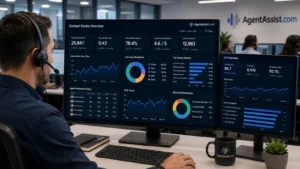

Key Takeaways
- Fraud-risk conversations are often hard to identify in contact centers due to normal call volume and subtle cues.
- A structured approach, using AI-supported workflows, can help flag fraud-risk conversations for proper review.
- Contact centers should not equate flagged calls with confirmed fraud; instead, they should route them for human assessment.
- Key indicators for fraud-risk include unauthorized activity, account access issues, and suspicious behavior.
- AgentAssist.com offers tools like Case Management and Conversation Analytics to streamline the review process.
Estimated reading time: 12 minutes
Table of contents
- What Is a Fraud-Risk Conversation?
- Why Fraud-Risk Calls Are Easy to Miss
- Common Fraud-Risk Indicators in Contact Center Conversations
- Why Fraud-Risk Review Is Safer Than Fraud Detection Claims
- How Contact Centers Can Flag Fraud-Risk Conversations
- How Case Management Supports Fraud-Risk Review
- How Conversation Analytics Helps Identify Patterns
- How Call Classification Supports Fraud-Risk Review
- How PII Redaction Supports Fraud-Risk Workflows
- How Fraud-Risk Review Supports QA and Coaching
- What Contact Centers Should Avoid
- What to Look for in Fraud-Risk Conversation Review Software
- How AgentAssist.com Helps Contact Centers Review Fraud-Risk Conversations
- Final Thoughts
- Key Takeaways
- Ready to review fraud-risk conversations with more structure?
Fraud-risk conversations can be difficult for contact centers to identify at scale. A customer may mention unauthorized activity, suspicious account access, a disputed transaction, a failed verification attempt, or a concern that something unusual happened. These calls may need closer review, but they can easily get buried inside normal call volume.
That is why contact centers need a structured way to flag fraud-risk conversations for review.
AI should not be positioned as automatically proving fraud or replacing trained reviewers. A safer and more accurate approach is to say that AI-supported workflows can help contact centers identify conversations that may contain fraud-risk indicators, route them into a review process, and help supervisors or subject matter experts decide what action is needed.
AgentAssist.com supports this workflow through Case Management, Conversation Analytics, Call Classification, Automated QA, Agent Coaching, Call Summarization, Real-Time Assist, and Analytics. Its Case Management solution helps teams create customized cases, receive alerts, review flagged calls, add notes, classify non-issues, escalate concerns, and generate reports.
What Is a Fraud-Risk Conversation?
A fraud-risk conversation is a customer interaction that includes language, topics, or patterns that may require closer review for potential fraud, unauthorized activity, account misuse, identity concerns, or suspicious behavior.
This does not mean fraud has definitely happened. It means the conversation contains a signal that may deserve attention.
For example, a customer may say they do not recognize a transaction. Another may report that someone accessed their account. Another may fail a verification process multiple times. Another may mention that they received a suspicious message claiming to be from the company.
Each of these situations may need a different response. Some may be simple misunderstandings. Some may be service issues. Some may need risk review. Some may require escalation.
The goal of fraud-risk conversation review is to help contact centers identify these calls faster and move them into the right workflow.
Why Fraud-Risk Calls Are Easy to Miss

Fraud-risk conversations are easy to miss because they do not always sound dramatic. A customer may calmly mention an unauthorized charge. An agent may resolve part of the issue but not escalate the pattern. A call may be labeled as “billing question” even though it included a fraud-risk concern.
In many contact centers, important signals are hidden inside:
- Manual call notes
- Broad disposition codes
- Long transcripts
- Random QA samples
- Separate ticketing systems
- Supervisor inboxes
- Agent memory
This creates a visibility problem. If leaders cannot easily find fraud-risk conversations, they cannot review them consistently, track patterns, or improve workflows.
A structured case management process helps reduce that gap.
Common Fraud-Risk Indicators in Contact Center Conversations
Fraud-risk indicators should be defined by the business based on its industry, policies, workflows, and customer risks. A bank, healthcare support team, insurance provider, telecom company, subscription business, or retail contact center may each need different criteria.
Common indicators may include:
- Customer reports unauthorized activity
- Customer does not recognize a transaction
- Customer says their account was accessed by someone else
- Customer mentions identity theft
- Customer fails verification repeatedly
- Customer provides inconsistent account information
- Customer asks about suspicious messages or emails
- Customer reports a scam attempt
- Customer mentions a changed address, phone number, or payment method they did not authorize
- Customer describes repeated account access problems
- Agent identifies a procedure concern
- Customer requests urgent account changes under unusual circumstances
These indicators should be treated as review triggers, not final conclusions.
Why Fraud-Risk Review Is Safer Than Fraud Detection Claims
Many companies use the phrase “fraud detection,” but AgentAssist.com content is stronger and safer when it frames the workflow as fraud-risk review.
Fraud detection can imply that software confirms fraud automatically. Fraud-risk review is a more accurate and safer phrase for many contact center workflows. It means the system helps identify conversations that may contain fraud-related signals and routes them to the right people for review.
That distinction protects the message.
A flagged call may turn out to be:
- A confirmed concern
- A misunderstanding
- A normal customer issue
- A process problem
- A coaching opportunity
- A non-issue
- A case requiring escalation
The value is not in accusing the customer or the agent. The value is in making sure important conversations are reviewed instead of missed.
How Contact Centers Can Flag Fraud-Risk Conversations
A contact center can flag fraud-risk conversations using selected criteria such as keywords, call classifications, metadata, customer intent categories, call duration, agent notes, or business-specific rules.
A practical workflow may look like this:
- The contact center defines which fraud-risk indicators should be reviewed.
- Customer conversations are analyzed using selected criteria.
- Calls matching those criteria are flagged for review.
- The flagged calls move into a case management workflow.
- Supervisors, risk teams, QA leaders, or subject matter experts review the interaction.
- Reviewers classify the case as a non-issue, concern, escalation, coaching opportunity, or follow-up item.
- Notes and next steps are added.
- Reports help leaders track patterns, outcomes, and recurring issues.
This workflow gives the contact center a repeatable process. It also helps avoid relying only on random review or manual escalation.
How Case Management Supports Fraud-Risk Review
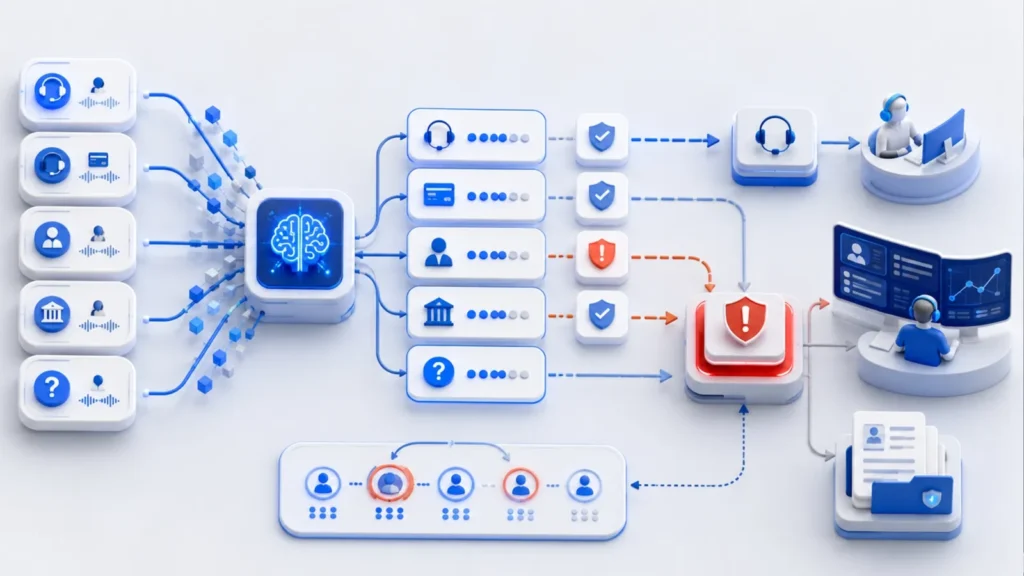
Case management is the center of fraud-risk conversation review. Without case management, flagged calls may become disconnected alerts or scattered notes.
AgentAssist.com Case Management solution helps contact centers create customized cases, quickly review and classify flagged calls, add notes, send alerts and notifications, and generate customized reports. Its page specifically references customized cases related to compliance, service, fraud, risk, and escalations.
This makes the workflow practical.
A supervisor can review a flagged call and mark it as a non-issue. A risk team member can escalate a real concern. A QA leader can identify a coaching opportunity. A manager can review reports to understand whether certain fraud-risk categories are increasing.
The goal is not just to find calls. The goal is to manage them.
How Conversation Analytics Helps Identify Patterns
A single fraud-risk call may be important. A pattern of similar calls may be even more important.
Conversation analytics helps teams search and review customer interactions to identify patterns across large volumes of calls. AgentAssist.com Conversation Analytics platform supports filters, saved searches, call review, insight extraction, PII and sensitive data redaction, and customized reports.
This can help contact centers answer questions such as:
- Are customers reporting more unauthorized activity?
- Are account access concerns increasing?
- Are suspicious message complaints tied to a specific campaign or customer segment?
- Are certain call reasons connected to fraud-risk review?
- Are verification issues increasing in one queue or department?
- Are agents documenting risk-related calls consistently?
These questions help leaders move from individual call review to operational insight.
How Call Classification Supports Fraud-Risk Review
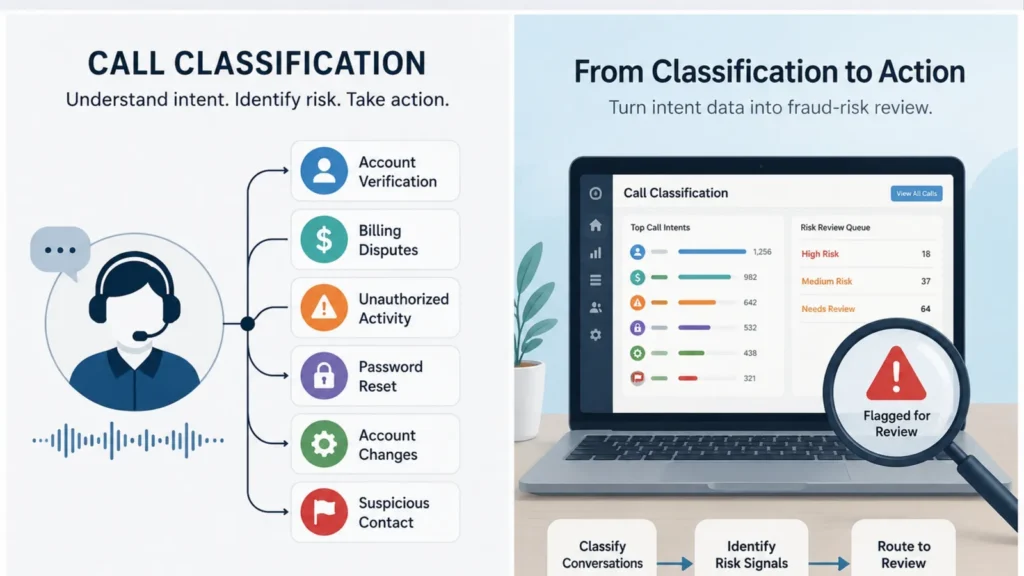
Call classification helps contact centers organize conversations by reason, intent, topic, or issue type. This can support fraud-risk review by making it easier to identify which calls may deserve closer attention.
For example, a contact center may classify calls related to account verification, billing disputes, unauthorized activity, suspicious contact, password resets, or account changes. Some of those classifications may be routine. Others may need case review based on selected criteria.
AgentAssist.com Call Classification solution helps teams understand why customers are contacting them, create customizable intent structures, listen to calls by classification, and track intent trends.
When call classification connects with case management, teams can turn classification data into action. A certain call category can become a review queue. A repeated pattern can become an operational concern. A flagged issue can become a documented case.
How PII Redaction Supports Fraud-Risk Workflows
Fraud-risk conversations often include sensitive customer information. Customers may discuss account numbers, payment details, identity verification, contact information, or other private details.
That makes data protection important.
AgentAssist.com Conversation Analytics platform includes the ability to customize redaction of PII and other sensitive data. This can help contact centers review important conversations while reducing unnecessary exposure of sensitive customer information.
PII redaction is especially useful when multiple teams may be involved in review. A supervisor, QA leader, risk reviewer, or operations manager may need conversation context, but not every person needs access to every sensitive detail.
Redaction helps preserve useful context while supporting better customer data protection practices.
How Fraud-Risk Review Supports QA and Coaching
Fraud-risk conversation review can reveal QA and coaching needs.
For example, a flagged call may show that an agent needs help with verification steps, documentation, escalation procedures, sensitive information handling, or explaining next steps to a customer. It may also show that an agent followed the right process and handled a difficult situation well.
This is important because fraud-risk review should not only be about finding problems. It should also help improve team performance.
AgentAssist.com Automated QA platform supports customized scorecards and quality monitoring workflows. Its Agent Coaching platform supports coaching tasks, notes, timestamps, alerts, and reporting. When these workflows connect with case management, supervisors can turn flagged conversations into practical coaching opportunities.
A good coaching workflow may answer:
- Did the agent follow the correct process?
- Did the agent document the issue clearly?
- Did the agent know when to escalate?
- Did the agent protect sensitive information?
- Did the agent explain next steps to the customer?
- Does the team need better guidance for similar calls?
This turns fraud-risk review into a learning system.
What Contact Centers Should Avoid
Fraud-risk workflows need careful language and careful process.
Contact centers should avoid treating every flagged call as confirmed fraud. That can lead to unnecessary escalation, poor customer experience, and unfair conclusions. A flag should simply mean the call deserves review.
Teams should also avoid criteria that are too broad. If every account access call becomes a fraud-risk case, supervisors may become overwhelmed. If criteria are too narrow, important conversations may be missed.
The strongest approach is to refine criteria over time. Review outcomes should inform whether the rules are working. If too many non-issues are flagged, the criteria may need adjustment. If important calls are still being missed, the criteria may need to expand.
What to Look for in Fraud-Risk Conversation Review Software
Contact center leaders should look for software that helps identify, review, document, escalate, and report on fraud-risk conversations.
Important capabilities include:
- Custom case criteria
- Fraud-risk call flagging
- Keyword and metadata-based review
- Call classification
- Conversation search
- Saved searches and filters
- Case review queues
- Notes and follow-up actions
- Alerts and notifications
- Custom reports
- Automated QA connection
- Coaching workflow connection
- PII and sensitive data redaction
- Secure handling of customer information
The most important factor is workflow. A tool should not only identify possible issues. It should help the team review and act on them.
How AgentAssist.com Helps Contact Centers Review Fraud-Risk Conversations
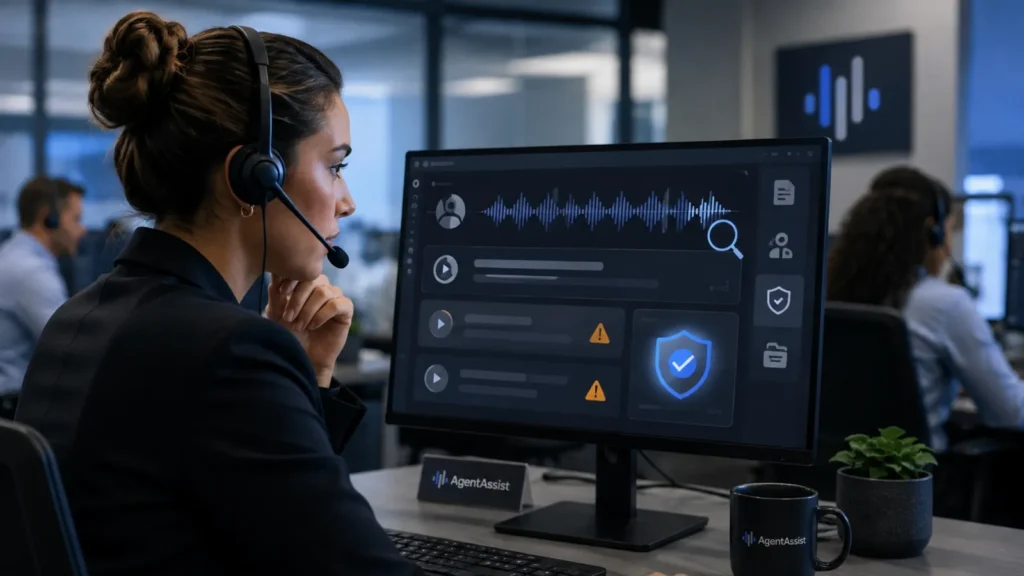
AgentAssist.com helps contact centers create a structured workflow for fraud-risk conversation review.
With AgentAssist.com, teams can use Case Management to create customized cases, review flagged calls, classify non-issues, escalate concerns, add notes, notify team members, and generate reports. Conversation Analytics helps teams search and filter conversations, create saved searches, review calls, and extract insights. Call Classification helps identify customer intent and call reason patterns. Automated QA and Agent Coaching help teams turn findings into performance improvement.
Together, these tools help contact centers move from scattered fraud-risk signals to organized review workflows.
Instead of hoping that every important call is manually escalated, teams can create a more consistent system for identifying, reviewing, and acting on conversations that may need attention.
Final Thoughts
Fraud-risk conversations can carry serious implications for customers and contact centers. These calls may involve unauthorized activity, identity concerns, disputed transactions, suspicious messages, verification issues, or other sensitive topics.
AI-supported workflows can help contact centers flag these conversations for review, but they should not be positioned as automatically proving fraud. Human review, clear criteria, proper documentation, and escalation workflows still matter.
AgentAssist.com helps contact centers connect fraud-risk conversation review with Case Management, Conversation Analytics, Call Classification, Automated QA, Agent Coaching, Call Summarization, Real-Time Assist, and Analytics. That creates a stronger process for finding important calls, reviewing them faster, protecting customer information, and improving contact center operations.
Key Takeaways
- Fraud-risk conversation review helps contact centers identify calls that may need supervisor, risk, QA, or compliance review.
- Fraud-risk indicators may include unauthorized activity concerns, verification issues, account access problems, disputed transactions, or repeated suspicious patterns.
- A flagged call should not be treated as confirmed fraud. It should be reviewed by the right team.
- Case management helps contact centers move fraud-risk conversations from scattered call notes into a structured review workflow.
- AgentAssist.com helps teams connect fraud-risk conversation review with Case Management, Conversation Analytics, Call Classification, Automated QA, Agent Coaching, Call Summarization, Real-Time Assist, and Analytics.
Fraud-risk conversation review in contact centers refers to identifying conversations that may involve unauthorized activity, suspicious account behavior, identity concerns, disputed transactions, or other fraud-risk indicators and routing them for human review.
No. A flagged call means the conversation may need review. It does not automatically confirm fraud or wrongdoing.
Contact centers can flag fraud-risk conversations using selected criteria such as keywords, metadata, call classifications, customer intent categories, suspicious activity language, or business-specific rules.
Case management helps teams review flagged calls, add notes, classify non-issues, escalate real concerns, send alerts, and track outcomes through reports.
Fraud-risk conversations often include sensitive customer information. PII redaction helps reduce unnecessary exposure of private details during review, QA, reporting, and coaching workflows.
AgentAssist.com supports fraud-risk conversation review through Case Management, Conversation Analytics, Call Classification, Automated QA, Agent Coaching, Call Summarization, Real-Time Assist, and Analytics.
Ready to review fraud-risk conversations with more structure?
See how AgentAssist.com helps contact centers flag important calls, manage case workflows, protect sensitive information, and turn customer conversations into actionable insights. Book a demo today.
Sources Used
- AgentAssist.com — Case Management
https://agentassist.com/platform/case-management/ - AgentAssist.com — Conversation Analytics
https://agentassist.com/platform/conversation-analytics/ - AgentAssist.com — Call Classification
https://agentassist.com/platform/call-classification/ - AgentAssist.com — Automated QA
https://agentassist.com/platform/automated-qa/ - AgentAssist.com — Agent Coaching
https://agentassist.com/platform/agent-coaching/ - AgentAssist.com — Call Summarization
https://agentassist.com/platform/call-summarization/ - AgentAssist.com — Real-Time Assist
https://agentassist.com/platform/real-time-assist/ - AgentAssist.com — Analytics
https://agentassist.com/platform/analytics/ - AgentAssist.com — Homepage
https://agentassist.com/ - FTC — ReportFraud.ftc.gov
https://reportfraud.ftc.gov/ - FTC — Explore Data
https://www.ftc.gov/news-events/explore-data - Google Search Central — Creating Helpful, Reliable, People-First Content
https://developers.google.com/search/docs/fundamentals/creating-helpful-content