
Key Takeaways
- Customer intent analytics helps contact centers understand what customers aim to achieve during calls, enhancing decision-making.
- It differs from call reason analytics by focusing on customer goals rather than just the reason for the call.
- Understanding customer intent allows teams to improve workflows, coach agents, and enhance the overall customer experience.
- AgentAssist.com supports customer intent analytics through various tools like Call Classification, Analytics, and Real-Time Assist.
- Using customer intent data effectively reduces operational friction and helps address repeated issues within customer interactions.
Estimated reading time: 14 minutes
Table of contents
- What Is Customer Intent Analytics?
- Why Customer Intent Matters in Contact Centers
- Customer Intent Analytics vs. Call Reason Analytics
- How Customer Intent Analytics Works
- How Customer Intent Analytics Improves Contact Center Reporting
- How Customer Intent Analytics Supports QA
- How Customer Intent Analytics Supports Agent Coaching
- How Customer Intent Analytics Supports Case Management
- How Customer Intent Analytics Supports Call Summarization
- How Customer Intent Analytics Supports Real-Time Assist
- Common Mistakes Contact Centers Make With Customer Intent Data
- What to Look for in Customer Intent Analytics Software
- How AgentAssist.com Helps Contact Centers Understand Customer Intent
- Key Takeaways
- FAQ
- Ready to understand what your customers are trying to accomplish?
- Helpful Resources
- You May Also Be Interested In…
Customer intent analytics helps contact centers understand what customers are trying to accomplish when they call. Instead of only tracking call volume, handle time, or basic disposition codes, customer intent analytics helps teams identify the reason behind the interaction.
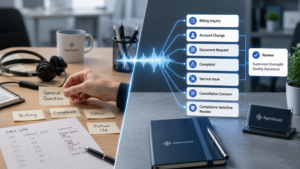
A customer may call because they need to update an account, resolve a billing issue, request documentation, ask about a payment, cancel a service, clarify a policy, or follow up on a previous unresolved issue. Each of these conversations contains intent. When contact centers can organize those intents clearly, they can make better decisions about staffing, training, self-service content, QA review, coaching, case management, and customer experience.
AgentAssist.com supports this type of workflow through Call Classification, Conversation Analytics, Analytics, Automated QA, Case Management, Agent Coaching, Call Summarization, and Real-Time Assist. Its Call Classification solution is designed to help businesses understand why customers are contacting them, identify intent trends, and use call reason data to improve operations.
What Is Customer Intent Analytics?
Customer intent analytics is the process of analyzing customer conversations to understand the purpose behind each interaction. In a contact center, customer intent usually refers to what the customer wants to do, solve, confirm, change, or request.
For example, a customer may be calling to:
• Understand a charge
• Update account information
• Request a document
• Ask about a payment
• Fix a technical problem
• Cancel a service
• Follow up on a previous issue
• File a complaint
• Speak with a supervisor
• Confirm a policy
• Resolve an access issue
• Get help completing a process
These are not just call labels. They are signals about customer needs.
When contact centers understand customer intent, they can see why customers are contacting the business. That makes it easier to identify common issues, improve workflows, support agents, and reduce friction across the customer journey.
Why Customer Intent Matters in Contact Centers
Many contact centers track basic performance metrics such as call volume, average handle time, abandonment rate, transfer rate, and first contact resolution. These metrics are useful, but they do not always explain why customers are calling.
For example, call volume may increase during a certain week. Without customer intent analytics, leadership may assume the issue is staffing. But the real reason may be that customers received a confusing email, a billing change caused questions, a digital process failed, or a new policy created uncertainty.
Customer intent analytics helps leaders ask better questions.
Instead of only asking, “How many calls did we receive?” teams can ask:
• Why are customers calling?
• What are they trying to accomplish?
• Which intents are increasing?
• Which customer goals are creating friction?
• Which call types are leading to repeat contact?
• Which intents are tied to escalations?
• Which issues should QA teams review more closely?
• Which processes need clearer customer communication?
This moves the contact center from basic reporting to operational intelligence.
Customer Intent Analytics vs. Call Reason Analytics
Customer intent analytics and call reason analytics are closely related, but they are not exactly the same.
Call reason analytics focuses on why the customer contacted the business. Customer intent analytics focuses on what the customer is trying to accomplish.
For example, the call reason may be “billing issue.” The customer intent may be “understand why my payment increased” or “request a correction for a duplicate charge.”
The call reason may be “account update.” The customer intent may be “change my address,” “update payment details,” or “add an authorized user.”
The call reason may be “technical support.” The customer intent may be “reset my login,” “fix access to the portal,” or “complete an online form.”
This distinction matters because broad call reasons can hide important differences. Customer intent analytics gives contact centers more detail about the actual customer goal.
How Customer Intent Analytics Works

Customer intent analytics typically uses conversation data to identify patterns in what customers are asking for. In an AI-powered contact center platform, this may involve call transcription, call classification, keyword recognition, configured categories, filters, dashboards, reports, and review workflows.
A practical customer intent analytics workflow may look like this:
1- A customer contacts the business.
2- The conversation is captured and transcribed.
3- The interaction is analyzed for keywords, phrases, call reasons, topics, and customer intent signals.
4- The call is classified into one or more intent categories.
5- Managers review intent trends through dashboards, reports, saved searches, or filtered conversations.
6- QA, coaching, compliance, operations, or customer experience teams review the most relevant interactions.
7- The business uses those insights to improve workflows, scripts, training, self-service content, and customer communication.
This process helps contact centers turn conversation data into something teams can use.
Examples of Customer Intent Categories
Every contact center will have different customer intent categories based on its industry, products, services, and workflows. A financial services contact center may track different intents than a healthcare, insurance, retail, utility, or software support team.
Common customer intent categories may include:
• Billing explanation
• Payment assistance
• Refund request
• Account verification
• Account update
• Password or login help
• Document request
• Service cancellation
• Product question
• Technical support
• Complaint follow-up
• Escalation request
• Policy clarification
• Appointment scheduling
• Status update
• Missing information
• Service issue
• Fraud-risk conversation
• Compliance-sensitive topic
These categories help leaders understand customer demand more clearly. They also help teams see where customers may be getting stuck.
How Customer Intent Analytics Improves Contact Center Reporting
Contact center reporting becomes more useful when customer intent is included.
A standard report may show total calls, average handle time, and resolution rate. A stronger report may show which customer intents are driving those numbers.
For example, a report may reveal that:
• Payment assistance calls are increasing after invoice reminders.
• Document request calls are tied to unclear instructions.
• Account verification calls are creating longer handle times.
• Cancellation concerns are increasing after a service change.
• Complaint follow-ups are tied to unresolved previous interactions.
• Login help calls are rising because customers cannot complete a self-service process.
This type of reporting gives leaders a clearer path to action.
AgentAssist.com Conversation Analytics platform supports filters, saved searches, call review, insight extraction, and customized reports. Its Analytics platform supports customizable analytics and reporting. Together, these capabilities can help contact centers understand customer intent patterns and act on them.
How Customer Intent Analytics Supports QA
Customer intent analytics can make QA more focused and practical. Instead of reviewing only random samples, QA teams can target specific intent categories.
For example, QA leaders may want to review:
• Calls where customers asked to cancel
• Calls where customers requested a supervisor
• Calls involving complaint language
• Calls with repeated billing confusion
• Calls tied to compliance-sensitive topics
• Calls involving account verification
• Calls with long handle times
• Calls where customers mentioned a prior unresolved issue
This helps QA teams review calls that matter most. It also gives them more context when evaluating agent performance.
If a customer intent category is difficult for many agents, the issue may not be one individual agent. The team may need a clearer process, updated knowledge base content, improved scripting, or better customer communication.
AgentAssist.com Automated QA platform supports customized scorecards and quality monitoring workflows, helping teams evaluate interactions more consistently.
How Customer Intent Analytics Supports Agent Coaching

Customer intent analytics can help supervisors coach agents with more precision.
Without intent data, coaching may be too general. A supervisor may tell an agent to improve call control, reduce handle time, or provide clearer explanations. Those suggestions may be useful, but they may not address the specific challenge the agent is facing.
With customer intent analytics, coaching can become more specific.
For example, supervisors may identify that an agent needs support with:
• Explaining billing changes
• Handling cancellation concerns
• Managing escalation requests
• Guiding customers through account verification
• Responding to complaint language
• Clarifying policy questions
• Helping customers complete a process
• Documenting follow-up actions
AgentAssist.com Agent Coaching platform is designed to help supervisors connect insights to coaching workflows through tasks, notes, timestamps, alerts, and reporting. This helps coaching become more connected to real customer conversations.
How Customer Intent Analytics Supports Case Management
Some customer intents may need supervisor review, escalation, or follow-up. These may include complaints, service failures, compliance-sensitive conversations, fraud-risk indicators, escalation language, or unresolved issues.
AgentAssist.com Case Management solution helps teams flag calls based on selected criteria, review cases, classify non-issues, add notes, send alerts, and escalate concerns when needed.
This is important because customer intent analytics should not stop at reporting. If a certain intent signals risk, dissatisfaction, or follow-up need, the contact center should have a workflow for reviewing and acting on those conversations.
For example, a customer intent category such as “supervisor request” may need case review. A category such as “complaint follow-up” may need trend tracking. A category such as “required disclosure review” may need QA or compliance attention.
The goal is not to assume that every flagged call is a problem. The goal is to help teams review the right conversations faster.
How Customer Intent Analytics Supports Call Summarization
Customer intent analytics also works well with call summarization.
When a conversation summary includes the customer’s goal, the issue discussed, the outcome, and any next steps, future agents and supervisors can understand the interaction faster.
This is especially useful when customers call back. If the previous conversation was summarized clearly, the next agent does not have to start from zero. The agent can see what the customer wanted, what was discussed, what action was taken, and what still needs to happen.
AgentAssist.com Call Summarization platform supports concise summaries of customer conversations, including key details, outcomes, and follow-up context.
This can improve continuity across customer interactions.
How Customer Intent Analytics Supports Real-Time Assist

Customer intent analytics can also support real-time guidance when connected with the right workflows.
If a customer mentions a specific issue, process, or request during a live conversation, a real-time assist system can help agents follow the right steps, reference relevant information, or stay aligned with internal procedures.
For example, when a customer intent is related to account verification, cancellation concern, payment assistance, or complaint handling, agents may benefit from contextual prompts or workflow reminders.
Real-Time Assist can help agents with contextual prompts and guidance, but it should not be treated as guaranteeing perfect outcomes or predicting every customer need.
AgentAssist.com Real-Time Assist platform supports in-conversation guidance that can help agents stay aligned with workflows and customer needs.
Common Mistakes Contact Centers Make With Customer Intent Data
Customer intent analytics becomes less useful when teams do not structure it carefully.
Common mistakes include:
• Using intent categories that are too broad
• Creating too many overlapping categories
• Treating customer intent as the same thing as call outcome
• Relying only on manual disposition codes
• Not reviewing whether categories match real customer language
• Ignoring calls with multiple intents
• Not connecting intent data to QA or coaching
• Not using intent data to improve self-service content
• Failing to monitor changes in intent trends over time
• Letting intent data sit in reports without operational action
The value is not just in collecting customer intent data. The value comes from using it to improve decisions.
What to Look for in Customer Intent Analytics Software
When evaluating customer intent analytics software, contact center leaders should look for tools that connect insight to workflow.
Important capabilities include:
• AI-powered call classification
• Customer intent classification
• Call reason analytics
• Conversation search
• Filters and saved searches
• Custom reports
• Dashboards
• Intent trend tracking
• Ability to review calls by classification
• Automated QA workflows
• Agent coaching workflows
• Case management workflows
• Call summarization
• Real-time assist capabilities
• Alerts and notifications
• Secure handling of sensitive information
AgentAssist.com fits this model because customer intent analytics connects with its broader contact center AI platform. Call Classification helps teams understand why customers are contacting them. Conversation Analytics helps teams search, filter, review, and report on conversations. Automated QA, Case Management, Agent Coaching, Call Summarization, Real-Time Assist, and Analytics help teams turn intent data into action.
How AgentAssist.com Helps Contact Centers Understand Customer Intent
AgentAssist.com helps contact centers understand customer intent by organizing conversations into useful categories and connecting those insights to practical workflows.
With AgentAssist.com, customer intent analytics can support:
• Customer intent classification
• Call reason tracking
• Intent trend analysis
• Conversation search
• Saved searches and filters
• Custom reporting
• Dashboard review
• QA prioritization
• Coaching workflows
• Case review
• Escalation review
• Call summarization
• Operational decision-making
This gives contact center leaders a clearer view of what customers need and where processes may be creating friction.
Instead of treating every call as a separate event, AgentAssist.com helps teams see patterns across conversations. Those patterns can help improve training, customer communication, self-service resources, quality monitoring, and customer experience.
Customer intent analytics helps contact centers understand what customers are trying to accomplish when they call. That makes it one of the most useful ways to improve reporting, reduce friction, support agents, and strengthen customer experience.
Basic call volume data can tell leaders how many customers are calling. Customer intent analytics helps explain why they are calling and what they need.
For modern contact centers, that difference matters. When teams can classify customer intent, search conversations, review trends, connect insights to QA, coach agents, manage flagged cases, and summarize interactions, customer conversations become more useful business intelligence.
AgentAssist.com helps contact centers connect customer intent analytics with Call Classification, Conversation Analytics, Automated QA, Case Management, Agent Coaching, Call Summarization, Real-Time Assist, and Analytics. That creates a more complete system for turning customer interactions into operational insight.
Key Takeaways
• Customer intent analytics helps contact centers understand what customers are trying to accomplish when they call.
• It goes beyond basic call volume by organizing conversations around customer goals, call reasons, and issue types.
• Customer intent classification can help teams identify repeated issues, rising trends, service gaps, and operational friction.
• Better intent data can support contact center analytics, QA review, coaching workflows, case management, and call summarization.
• AgentAssist.com helps contact centers connect customer intent analytics with Call Classification, Conversation Analytics, Automated QA, Case Management, Agent Coaching, Call Summarization, Real-Time Assist, and Analytics.
FAQ
Customer intent analytics is the process of analyzing customer conversations to understand what customers are trying to accomplish, such as resolving a billing issue, updating an account, requesting a document, or following up on a service problem.
Call reason explains why the customer contacted the business. Customer intent explains what the customer is trying to do or achieve during the interaction.
Customer intent helps contact centers understand customer needs, identify repeated issues, improve workflows, support QA review, guide coaching, and improve customer experience.
Yes. Customer intent analytics can help QA teams review specific categories of calls, such as cancellation requests, complaint calls, escalation requests, or compliance-sensitive conversations.
Yes. It can help teams identify repeated customer goals, unresolved issues, confusing processes, and workflow gaps that may be driving repeat contact.
AgentAssist.com supports customer intent analytics through Call Classification, Conversation Analytics, Analytics, Automated QA, Case Management, Agent Coaching, Call Summarization, and Real-Time Assist.
Ready to understand what your customers are trying to accomplish?
See how AgentAssist.com helps contact centers classify customer intent, identify trends, improve reporting, and turn conversations into actionable insights. Book a demo today.
Helpful Resources
AgentAssist.com — Call Classification
https://agentassist.com/platform/call-classification/
AgentAssist.com — Conversation Analytics
https://agentassist.com/platform/conversation-analytics/
AgentAssist.com — Analytics
https://agentassist.com/platform/analytics/
AgentAssist.com — Automated QA
https://agentassist.com/platform/automated-qa/
AgentAssist.com — Case Management
https://agentassist.com/platform/case-management/
AgentAssist.com — Call Summarization
https://agentassist.com/platform/call-summarization/
AgentAssist.com — Agent Coaching
https://agentassist.com/platform/agent-coaching/
AgentAssist.com — Real-Time Assist
https://agentassist.com/platform/real-time-assist/
AgentAssist.com — Homepage
https://agentassist.com/
Google Search Central — Creating Helpful, Reliable, People-First Content
https://developers.google.com/search/docs/fundamentals/creating-helpful-content