
Key Takeaways
- QA calibration ensures consistent scoring among reviewers in contact centers, fostering trust and reliability.
- Inconsistent QA scores can harm agent trust, confuse coaching efforts, and weaken leadership confidence in quality reports.
- Effective calibration processes involve clear scorecard criteria, scoring rationale, and frequent review of real calls.
- Automated QA enhances calibration by applying consistent scorecards and providing detailed scoring rationale for better insights.
- AgentAssist.com integrates solutions for QA calibration, including scorecards, coaching, and analytics, to improve scoring consistency and quality monitoring.
Estimated reading time: 14 minutes
Table of contents
- What Is QA Calibration in a Contact Center?
- Why QA Calibration Matters
- Common Signs Your QA Program Needs Calibration
- How QA Calibration Works
- The Role of Scorecard Clarity
- Why Scoring Rationale Matters
- How Automated QA Supports Calibration
- Calibration Should Include Real Calls
- QA Calibration and Agent Appeals
- QA Calibration and Coaching Consistency
- How Often Should Contact Centers Calibrate QA?
- What to Discuss in a QA Calibration Session
- How Analytics Supports QA Calibration
- Common QA Calibration Mistakes
- What to Look for in QA Calibration Software
- How AgentAssist.com Helps Contact Centers Improve QA Calibration
- Final Thoughts
- Key Takeaways
- Ready to make QA scoring more consistent?
QA calibration in contact centers is the process of making sure quality reviewers score customer interactions consistently. When multiple QA reviewers, supervisors, or team leads evaluate calls, they should apply the same scorecard criteria in the same way. Without calibration, one reviewer may score a call as excellent while another may score the same call as average.
That creates problems.
Agents may lose trust in the QA process. Supervisors may disagree with the results. Coaching may become inconsistent. Leadership may make decisions based on score trends that are not fully reliable. The contact center may think quality is improving or declining when the real issue is scoring inconsistency.
QA calibration helps solve this by aligning reviewers around clear expectations, scorecard definitions, scoring rationale, and review standards. It gives contact centers a better way to make quality monitoring fair, repeatable, and useful.
AgentAssist.com supports this workflow through Automated QA, Agent Coaching, Analytics, Conversation Analytics, Call Classification, Case Management, Call Summarization, and Real-Time Assist. Its Automated QA platform supports customized scorecards, scoring rationale, multiple scorecards per call or agent, and reporting. These capabilities help contact centers create a more consistent QA process and connect results to coaching and improvement.
What Is QA Calibration in a Contact Center?
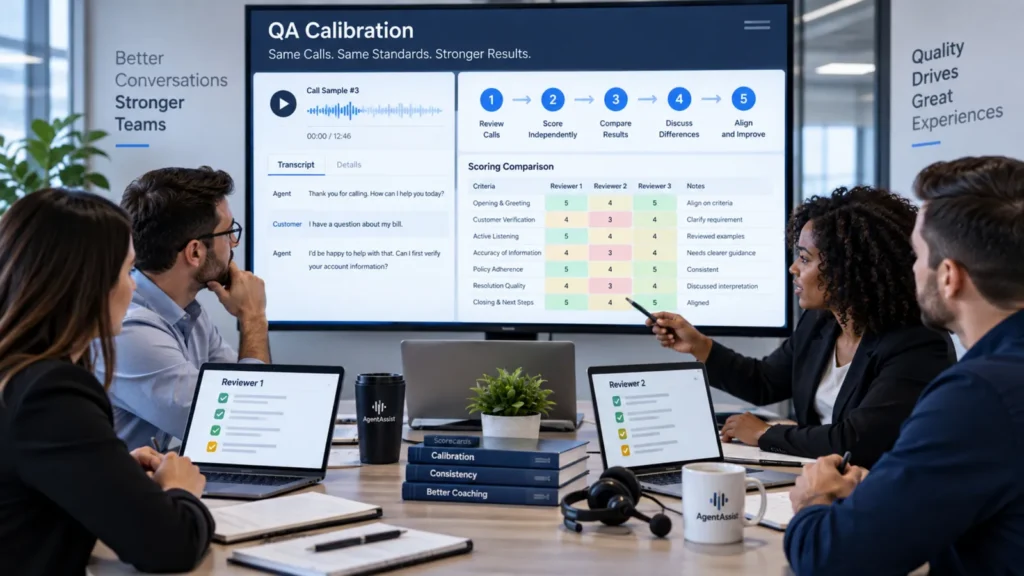
QA calibration is a structured review process where multiple reviewers evaluate the same customer interaction and compare their scores. The goal is to identify scoring differences, discuss why those differences happened, and align everyone around the correct interpretation of the scorecard.
For example, two reviewers may both listen to the same call. One reviewer gives the agent full credit for issue resolution. Another reviewer removes points because the agent did not clearly explain the next step. During calibration, the team discusses the scorecard criteria and decides how that situation should be scored in the future.
The goal is not to force every reviewer to think exactly the same way. The goal is to make scoring standards clearer so that reviews are fair and consistent.
In simple terms, QA calibration answers this question:
Are we scoring the same behavior the same way?
Why QA Calibration Matters
QA scores influence coaching, performance discussions, process improvements, compliance-risk review, and leadership reporting. If those scores are inconsistent, the entire quality program becomes weaker.
Inconsistent scoring can create several issues.
Agents may feel the process is unfair. A score may depend more on who reviewed the call than what happened during the conversation. Supervisors may spend time debating QA results instead of coaching agents. QA leaders may struggle to identify real performance trends. Leadership may lose confidence in quality reports.
Calibration helps improve credibility.
When reviewers are aligned, agents are more likely to trust the feedback. Supervisors can coach with more confidence. QA leaders can report on trends more accurately. Operations teams can identify whether issues are agent-specific, team-wide, or process-related.
Common Signs Your QA Program Needs Calibration
A contact center may need stronger QA calibration if the same types of calls are being scored differently across reviewers. It may also need calibration if agents frequently appeal scores, supervisors challenge QA results, or score trends change without a clear operational reason.
Other warning signs include:
- Reviewers disagree on what a scorecard question means.
- Agents say feedback depends on the reviewer.
- QA scores vary widely between teams without clear cause.
- Coaching conversations focus more on arguing scores than improving behavior.
- Reviewers apply different standards to similar calls.
- Scorecards include vague criteria that are hard to interpret.
- New reviewers struggle to apply the scorecard consistently.
- Leadership does not trust QA reporting.
These issues do not always mean the reviewers are doing poor work. Often, they mean the scorecard needs clearer definitions, better examples, stronger training, or a more consistent calibration rhythm.
How QA Calibration Works

A practical QA calibration process does not need to be complicated. It needs to be consistent.
A basic calibration workflow may look like this:
- Select a small group of calls for review.
- Have multiple reviewers score the same calls independently.
- Compare the scores by question, category, and final result.
- Identify where reviewers disagreed.
- Discuss why the scoring differences happened.
- Clarify the correct interpretation of the scorecard criteria.
- Document the decision for future reviews.
- Update scorecard guidance if needed.
- Repeat calibration regularly.
This process helps reviewers build shared judgment over time. The more often teams calibrate, the easier it becomes to spot unclear criteria and align around scoring standards.
Calibration should not feel like a one-time training session. It should be an ongoing quality practice.
The Role of Scorecard Clarity
QA calibration becomes much easier when the scorecard is clear.
If a scorecard question is vague, reviewers will naturally interpret it differently. For example, a question like “Did the agent provide good service?” leaves too much room for opinion. One reviewer may focus on tone. Another may focus on accuracy. Another may focus on resolution.
A better scorecard question is more specific.
For example:
“Did the agent clearly confirm the customer’s issue before offering a solution?”
That question is easier to score because it focuses on observable behavior.
Strong scorecard criteria should be:
- Specific
- Observable
- Relevant to the call type
- Easy to explain to agents
- Connected to business goals
- Useful for coaching
- Consistent across reviewers
AgentAssist.com Automated QA platform supports customized scorecards, which gives contact centers the flexibility to create criteria that match their actual workflows.
Why Scoring Rationale Matters
Scoring rationale is one of the most important parts of QA consistency. A score tells the agent what happened numerically. Rationale explains why the score was assigned.
Without rationale, agents may not understand what they did well or what needs improvement. Supervisors may struggle to coach. QA leaders may have difficulty resolving disputes. Reviewers may repeat the same scoring inconsistencies.
AgentAssist.com Automated QA platform supports scorecards that provide both the score and the scoring rationale. This is useful for calibration because reviewers can compare not only the final score, but also the reasoning behind it.
For example, two reviewers may both remove points from a call, but for different reasons. One may remove points for incomplete documentation. Another may remove points for poor next-step clarity. Calibration helps decide which rationale is correct and how similar calls should be evaluated going forward.
A strong QA program should make the reasoning visible.
How Automated QA Supports Calibration
Automated QA can help support calibration by applying scorecards more consistently across more interactions. Instead of relying only on small manual samples, contact centers can use automated QA workflows to evaluate a larger number of conversations.
AgentAssist.com Automated QA platform supports customized automated scorecards, multiple scorecards per call or agent, scoring rationale, and a complete reporting suite. This can help contact centers identify scoring patterns and review performance at the agent, question, and scorecard level.
Automated QA does not remove the need for calibration. It changes how calibration works.
Human reviewers still need to validate criteria, review edge cases, refine scorecards, and decide whether the scoring logic matches the business process. Calibration remains important because the quality program still needs human judgment, context, and alignment.
The strongest approach is to use automation for scale and consistency, then use calibration to improve standards, scorecard design, and reviewer alignment.
Calibration Should Include Real Calls

QA calibration works best when it uses real customer conversations. Training examples can be helpful, but real calls reveal the messy situations reviewers actually face.
A customer may ask multiple questions in one call. An agent may follow the process but explain it awkwardly. A call may include both a routine issue and a complaint. A customer may be unclear about what they need. A required step may be partially completed. A call may be technically accurate but poorly documented.
These situations are exactly why calibration matters.
Real calls help teams answer practical scoring questions, such as:
- What counts as a complete resolution?
- How should partial compliance be scored?
- When should a missed documentation step affect the score?
- How should reviewers handle calls with multiple intents?
- What should happen when the agent follows policy but the customer remains confused?
- How should escalation language be evaluated?
- What should count as clear next-step communication?
Calibration gives the QA team a place to resolve these questions before they become ongoing disputes.
QA Calibration and Agent Appeals
Agent appeals can be a valuable part of the QA process when handled correctly. An appeal gives an agent a way to challenge a score, provide context, or ask for a second review.
Appeals should not be treated as a threat to QA. They can help reveal unclear scorecard criteria, inconsistent reviewer judgment, or missing context.
AgentAssist.com Agent Coaching platform includes the ability for agents to accept or appeal and send to a subject matter expert for review. This supports a more transparent feedback process.
When many agents appeal the same scorecard question, the issue may not be the agents. The issue may be the criteria. Calibration can help identify whether the scorecard needs clearer language or reviewer guidance.
A healthy appeal process can improve QA trust when it is tied to calibration and clear decision-making.
QA Calibration and Coaching Consistency
Calibration affects coaching quality.
If reviewers score calls inconsistently, supervisors may coach agents on the wrong behaviors. One agent may be told that a certain explanation is acceptable while another is told the same explanation is incomplete. That creates confusion and weakens the coaching process.
AgentAssist.com Agent Coaching platform supports tasks, notes, timestamps, alerts, customized agent portals, and tracking/reporting. These workflows work best when the QA findings behind them are consistent.
A calibrated QA process helps supervisors coach with clearer evidence. They can point to the scorecard criteria, the scoring rationale, and the exact moment in the call that needs discussion.
This makes coaching more specific and fair.
Instead of saying, “Your score was low,” a supervisor can say, “This call lost points because the next step was not clearly explained after the customer asked about follow-up. Let’s review how to close that type of call.”
That is a stronger coaching conversation.
How Often Should Contact Centers Calibrate QA?
The right calibration frequency depends on call volume, team size, risk level, and how often scorecards or workflows change.
A high-volume contact center may need weekly calibration sessions. A smaller team may calibrate biweekly or monthly. A team launching a new scorecard may need more frequent calibration during the first few weeks.
Calibration should also happen when:
- A new scorecard is introduced
- A business process changes
- A new team of reviewers is added
- Agents frequently appeal a scorecard category
- QA scores shift unexpectedly
- A compliance-sensitive workflow changes
- A new product, policy, or procedure is launched
The goal is not to create meetings for the sake of meetings. The goal is to keep scoring aligned as the business changes.
What to Discuss in a QA Calibration Session

A calibration session should be focused. It should not become a general complaint meeting about agents, reviewers, or scorecards.
A strong session should review a small number of calls, compare score differences, discuss specific criteria, and document decisions.
Useful discussion questions include:
- Which scorecard questions created the most disagreement?
- Was the disagreement caused by unclear criteria?
- Did reviewers have different interpretations of the same behavior?
- Was the call type matched to the right scorecard?
- Did the scoring rationale support the score?
- Should the scorecard language be updated?
- Should reviewer guidance include a new example?
- Does the finding need to connect to coaching?
This keeps calibration practical and action-oriented.
How Analytics Supports QA Calibration
Analytics helps QA leaders understand whether calibration is improving consistency over time.
AgentAssist.com Analytics platform supports native reporting, customizable analytics, dashboards, reports, embedded data visualization, alerts, notifications, security permissions, and redaction. These capabilities can help teams review QA trends, scorecard results, and reviewer alignment.
Useful calibration analytics may include:
- Score variation by reviewer
- Score trends by scorecard question
- Appeal volume by category
- Agent-level QA trends
- Team-level QA trends
- Frequent scoring disagreement areas
- Coaching topics tied to QA findings
- Scorecard categories that create confusion
These reports help QA leaders find where alignment is strong and where calibration needs more attention.
Common QA Calibration Mistakes
QA calibration can fail when teams treat it as a formality instead of a quality improvement process.
Common mistakes include:
- Calibrating too rarely
- Reviewing too many calls in one session
- Focusing only on final scores
- Ignoring scoring rationale
- Not documenting decisions
- Not updating unclear scorecard criteria
- Allowing dominant reviewers to control the discussion
- Failing to include supervisors who coach agents
- Not connecting calibration outcomes to training
- Treating appeals as complaints instead of feedback signals
A better calibration process is simple, focused, documented, and repeated.
What to Look for in QA Calibration Software
Contact center leaders should look for QA tools that support consistency, transparency, and action.
Important capabilities include:
- Customizable QA scorecards
- Automated QA scoring
- Multiple scorecards per call or agent
- Scoring rationale
- Question-level reporting
- Agent-level reporting
- Reviewer comparison
- Coaching workflow connection
- Notes and timestamps
- Agent accept/appeal workflows
- Reports and dashboards
- Conversation search and filters
- Secure permissions and redaction
AgentAssist.com fits this model because its Automated QA, Agent Coaching, Analytics, and Conversation Analytics capabilities support a more complete QA calibration workflow.
The important point is connection. Calibration should not be separate from scoring, reporting, coaching, and agent feedback. It should improve all of them.
How AgentAssist.com Helps Contact Centers Improve QA Calibration

AgentAssist.com helps contact centers strengthen QA calibration by connecting scorecards, scoring rationale, reporting, coaching, and conversation review.
With AgentAssist.com, teams can use customized automated scorecards, apply multiple scorecards to calls or agents, review scoring rationale, and use reporting to identify scorecard trends. Agent Coaching helps supervisors create notes, tasks, timestamps, alerts, agent portals, and appeal workflows. Analytics helps leaders monitor results through dashboards and reports. Conversation Analytics helps teams search and review calls when calibration questions arise.
This gives contact centers a more complete way to make QA scoring consistent and useful.
The goal is not just to score more calls. The goal is to score calls more fairly, explain results more clearly, and turn quality insights into better coaching.
Final Thoughts
QA calibration is one of the most important parts of contact center quality monitoring. Without calibration, scorecards can become inconsistent, agents can lose trust, supervisors can struggle to coach, and leaders may not fully trust QA reports.
A strong calibration process helps reviewers align around scorecard criteria, scoring rationale, and real customer interactions. It also helps contact centers improve scorecard design, reduce disputes, support fair coaching, and identify process issues.
AgentAssist.com helps contact centers connect QA calibration with Automated QA, Agent Coaching, Analytics, Conversation Analytics, Call Classification, Case Management, Call Summarization, and Real-Time Assist. That creates a stronger quality monitoring system built around consistency, transparency, and action.
Key Takeaways
- QA calibration helps contact centers make call scoring more consistent across reviewers.
- Without calibration, QA scores can vary because reviewers interpret scorecard criteria differently.
- Calibration improves trust, coaching quality, scorecard alignment, and reporting accuracy.
- Automated QA can support calibration by applying scorecards more consistently and providing scoring rationale.
- AgentAssist.com helps contact centers connect QA calibration with Automated QA, Agent Coaching, Analytics, Conversation Analytics, Case Management, Call Classification, Call Summarization, and Real-Time Assist.
QA calibration is the process of aligning reviewers so they score customer interactions consistently using the same scorecard criteria and expectations.
QA calibration helps improve scoring consistency, agent trust, coaching quality, reporting accuracy, and scorecard alignment.
Calibration frequency depends on call volume, team size, risk level, and workflow changes. Many teams calibrate weekly, biweekly, or monthly, with more frequent sessions when launching new scorecards.
Teams should review score differences, scorecard criteria, scoring rationale, call context, reviewer interpretations, appeal patterns, and whether scorecard guidance needs to be updated.
Automated QA can help apply scorecards consistently across more interactions, provide scoring rationale, and support reporting. Human calibration is still important for context, edge cases, and scorecard refinement.
AgentAssist.com supports QA calibration through Automated QA, customized scorecards, scoring rationale, reporting, Agent Coaching, notes, timestamps, accept/appeal workflows, Analytics, and Conversation Analytics.
Ready to make QA scoring more consistent?
See how AgentAssist.com helps contact centers create customized QA scorecards, review scoring rationale, align quality teams, and turn calibration insights into better coaching. Book a demo today.
Sources Used
- AgentAssist.com — Automated QA
https://agentassist.com/platform/automated-qa/ - AgentAssist.com — Agent Coaching
https://agentassist.com/platform/agent-coaching/ - AgentAssist.com — Analytics
https://agentassist.com/platform/analytics/ - AgentAssist.com — Conversation Analytics
https://agentassist.com/platform/conversation-analytics/ - AgentAssist.com — Case Management
https://agentassist.com/platform/case-management/ - AgentAssist.com — Call Classification
https://agentassist.com/platform/call-classification/ - AgentAssist.com — Call Summarization
https://agentassist.com/platform/call-summarization/ - AgentAssist.com — Real-Time Assist
https://agentassist.com/platform/real-time-assist/ - AgentAssist.com — Homepage
https://agentassist.com/ - Google Search Central — Creating Helpful, Reliable, People-First Content
https://developers.google.com/search/docs/fundamentals/creating-helpful-content