
Key Takeaways
- AI coaching for contact center agents enhances onboarding by providing real-time feedback and targeted coaching based on actual call data.
- Supervisors can utilize AI-supported workflows to identify coaching needs early, ensuring new agents receive timely interventions.
- Features like Automated QA, call summaries, and Real-Time Assist help new agents understand their performance and improve faster.
- Specific coaching tasks with notes and timestamps make feedback actionable and relevant to each agent’s performance.
- By connecting coaching efforts with analytics and reporting, organizations can improve both agent skills and overall onboarding processes.
Estimated reading time: 14 minutes
Table of contents
- Why New Contact Center Agents Need Better Coaching
- What Is AI Coaching for Contact Center Agents?
- The Problem With Traditional New Agent Training
- How Automated QA Helps New Agents Improve Faster
- How Coaching Tasks Turn Feedback Into Action
- Why Notes and Timestamps Matter for New Agents
- How Call Summaries Help New Agents Learn
- How Real-Time Assist Supports New Agents During Calls
- How Conversation Analytics Helps Supervisors Find Training Gaps
- Use Call Classification to Coach by Call Type
- Create a 30-Day New Agent Coaching Loop
- Balance Correction With Confidence
- How Agent Appeals Can Support Fair Coaching
- Use Coaching Data to Improve Onboarding
- What Contact Centers Should Avoid
- What to Look for in AI Coaching Software for New Agents
- How AgentAssist.com Helps New Contact Center Agents Improve Faster
- Final Thoughts
- Key Takeaways
- FAQs
- Ready to help new agents improve faster?
AI coaching for contact center agents helps supervisors support new hires with clearer feedback, better call examples, structured coaching tasks, QA insights, and performance visibility. For new agents, the first few weeks can be overwhelming. They need to learn customer workflows, product details, policies, procedures, scripts, systems, escalation paths, and documentation requirements while also handling real customer conversations.
Traditional onboarding often gives new agents a large amount of information before they are fully ready to use it. They may attend training sessions, review scripts, shadow experienced agents, and take practice calls. But once they begin live conversations, supervisors need a practical way to see where each agent needs support.
That is where AI-supported coaching can help. Instead of relying only on manual observation, random call samples, or delayed feedback, contact centers can use QA scorecards, conversation analytics, call summaries, coaching tasks, notes, timestamps, and real-time guidance to help new agents improve faster.
AgentAssist.com supports this type of workflow through Agent Coaching, Automated QA, Conversation Analytics, Call Classification, Call Summarization, Real-Time Assist, Case Management, and Analytics. The goal is not to replace supervisors. The goal is to give supervisors better tools to coach new agents with more consistency and context.
Why New Contact Center Agents Need Better Coaching
New agents enter a difficult environment. They are expected to understand the customer’s issue, use the right system, follow the correct process, communicate clearly, document the interaction, and know when to escalate. Even strong new hires need time to build confidence.
The challenge is that supervisors cannot listen to every call manually. A new agent may struggle with one type of call but perform well on another. They may understand the policy but forget to explain the next step. They may be friendly with customers but miss documentation. They may follow the script but fail to identify the customer’s real intent.
Without structured coaching, these issues may go unnoticed until they become repeated habits.
AI coaching helps make the learning process more visible. Supervisors can see which behaviors need attention, which calls should be reviewed, and which agents need extra support.
What Is AI Coaching for Contact Center Agents?
AI coaching for contact center agents is the use of AI-supported workflows to identify coaching opportunities, organize feedback, assign coaching tasks, and track agent improvement. It may include automated QA scorecards, conversation analytics, call summaries, call timestamps, coaching notes, alerts, dashboards, and contextual real-time prompts.
In simple terms, AI coaching helps answer three important questions.
What happened in the customer conversation?
What should the agent improve?
How can the supervisor help the agent get better?
For new agents, this is especially valuable because coaching needs to happen early and often. A new agent should not have to wait weeks to learn that they are missing a required step or struggling with a certain call type.
The Problem With Traditional New Agent Training
Traditional training often happens before the agent handles enough real calls to understand the complexity of the role. Classroom training, scripts, knowledge base articles, and role-playing are useful, but they cannot fully prepare an agent for live customer conversations.
The real learning happens when agents begin taking calls.
That is when they discover customers do not always follow the script. A customer may ask three questions at once. A billing issue may turn into a cancellation concern. A routine account update may involve verification problems. A technical support call may become an escalation. A customer may reference a prior unresolved issue that the agent has never seen before.
New agents need support inside this reality. They need coaching based on real calls, real customer questions, and real workflow challenges.
How Automated QA Helps New Agents Improve Faster
Automated QA can help supervisors identify new agent performance patterns more quickly. Instead of reviewing only a small sample of calls manually, automated QA can apply customized scorecards across more interactions and provide scoring rationale.
AgentAssist.com Automated QA platform supports customized automated scorecards, multiple scorecards per call or agent, scoring rationale, and reporting. This helps supervisors see where agents are performing well and where they need support.
For new agents, automated QA can help identify patterns such as missed verification steps, unclear explanations, incomplete documentation, weak call closings, or difficulty with specific call types.
This matters because early feedback prevents small issues from becoming long-term habits.
How Coaching Tasks Turn Feedback Into Action

Feedback is only useful when it leads to action. A supervisor may tell a new agent to improve, but if the feedback is vague, the agent may not know what to do next.
A coaching task makes the feedback specific.
For example:
- Review the call timestamp where the customer asked about next steps.
- Practice the account verification explanation with a supervisor.
- Complete a coaching module on billing dispute calls.
- Review three strong examples of cancellation concern conversations.
- Rewrite the post-call summary for the reviewed interaction.
- Listen to a call where the agent handled escalation language well.
AgentAssist.com Agent Coaching platform supports tasks, notes, timestamps, alerts, customized agent portals, and reporting. This helps supervisors create a clear coaching path instead of relying on informal reminders.
Why Notes and Timestamps Matter for New Agents
New agents often need specific examples. A general comment like “explain things more clearly” may not help. A timestamp and note can show the exact moment where the agent needed to do something differently.
For example, a supervisor might note:
“At 04:12, the customer asked what would happen next. This was the right moment to explain the follow-up timeline and confirm understanding.”
That feedback is easier to understand because it is tied to a real moment in the call.
AgentAssist.com Agent Coaching platform supports notes and call timestamps to aid coaching discussions. This is especially helpful for new agents because it turns coaching into a guided review instead of a broad performance critique.
How Call Summaries Help New Agents Learn
Call summaries can help new agents understand what happened during an interaction and what should have been documented. A strong summary can include the customer’s issue, key details, outcome, and follow-up context.
AgentAssist.com Call Summarization platform supports concise summaries of customer conversations. For new agents, this can help reduce confusion around after-call documentation and give supervisors better context for coaching.
Call summaries can support onboarding by helping new agents understand:
- What the customer wanted
- What action was taken
- What follow-up was needed
- Whether the issue was resolved
- What should be documented
- Where the conversation became difficult
This is useful because documentation is often one of the harder skills for new agents to master. They may know what happened in the call, but not how to capture it clearly.
How Real-Time Assist Supports New Agents During Calls
New agents often need help in the moment, not only after the call ends. Real-Time Assist can support them with contextual prompts, checklist-style guidance, and workflow reminders during live conversations.
AgentAssist.com Real-Time Assist platform includes contextual real-time prompts and navigator checklist functionality to help agents focus on key topics during calls. It also supports in-call suggested prompts based on conversation context.
For new agents, this can be useful when they are learning complex workflows. A prompt or checklist can help them remember important steps during account verification, complaint handling, escalation review, payment assistance, cancellation concerns, or required process flows.
Real-time guidance can help support agent consistency, but it should not be treated as guaranteeing perfect outcomes or predicting every customer need.
How Conversation Analytics Helps Supervisors Find Training Gaps
Conversation analytics helps supervisors search, filter, and review customer interactions. This can reveal where new agents are struggling and where the onboarding program may need improvement.
AgentAssist.com Conversation Analytics platform supports filters, saved searches, call review, insight extraction, customized reports, and PII redaction.
For new agent coaching, conversation analytics can help supervisors answer questions such as:
- Which call types are creating the most coaching needs?
- Are new agents struggling with the same workflow?
- Are customers asking questions that training does not cover clearly?
- Are certain procedures causing confusion?
- Are call summaries missing the same details?
- Are new agents escalating at the right time?
This helps leaders improve not only individual agents, but also the onboarding process itself.
Use Call Classification to Coach by Call Type

New agents rarely struggle equally across every type of call. One agent may need help with billing questions. Another may struggle with account verification. Another may do well on routine calls but need support with escalations.
Call classification helps supervisors understand why customers are contacting the business and how agents perform across different call types.
AgentAssist.com Call Classification solution supports customizable intent structures, call classification review, and intent trend tracking.
This matters for new agent coaching because it gives supervisors better context. Instead of saying, “Your calls are too long,” a supervisor can say, “Your payment assistance calls are taking longer because customers often ask the same follow-up question. Let’s review how to explain that step more clearly.”
That is more useful, more fair, and easier for the agent to act on.
Create a 30-Day New Agent Coaching Loop
New agent development should not be left to chance. A structured 30-day coaching loop can help supervisors support agents more consistently.
A simple new agent coaching loop may look like this:
- Review the agent’s first live calls.
- Identify the top two coaching priorities.
- Assign coaching tasks with notes and timestamps.
- Review QA scorecard results by call type.
- Use call summaries to check documentation quality.
- Provide real-time guidance where workflows are complex.
- Track whether coaching tasks are completed.
- Review improvement trends weekly.
- Recognize strong calls and positive progress.
- Adjust the coaching plan based on performance.
This type of workflow helps new agents build confidence step by step. It also helps supervisors focus on the most important behaviors first.
Balance Correction With Confidence
New agents need correction, but they also need confidence. If every coaching session focuses only on what went wrong, agents may become discouraged or overly cautious.
A strong coaching program should identify both improvement areas and strong examples.
A supervisor may coach an agent on missing a documentation step, then also recognize how well the agent handled a frustrated customer. Another agent may need help with call closing but deserve credit for accurately identifying the customer’s intent.
Positive coaching helps new agents understand what to repeat.
Strong examples can include:
- Clear explanation of next steps
- Strong issue discovery
- Good handling of escalation language
- Accurate documentation
- Proper verification flow
- Calm handling of a difficult conversation
- Good use of available guidance
This creates a coaching culture built around growth, not fear.
How Agent Appeals Can Support Fair Coaching
New agents may sometimes disagree with feedback or feel that context was missed. A fair coaching workflow should give agents a way to respond.
AgentAssist.com Agent Coaching platform supports the ability for agents to accept or appeal and send items to a subject matter expert for review.
This can be useful because it makes feedback more transparent. If an agent appeals a coaching item, the supervisor or expert can review the context. Sometimes the original feedback will stand. Other times, the appeal may reveal that the scorecard needs clarification or that the agent followed a process correctly.
For new agents, this creates trust. They can learn while still feeling that the process is fair.
Use Coaching Data to Improve Onboarding
AI coaching should not only improve individual agents. It should also improve the onboarding program.
If many new agents struggle with the same process, the problem may be the training material. If new agents miss the same documentation requirement, the workflow may need clearer examples. If they frequently ask for help on one call type, the training program may need more practice scenarios.
Coaching data can help training leaders identify which parts of onboarding need improvement.
For example, leaders may discover that new agents need more practice with:
- Billing disputes
- Account verification
- Complaint handling
- Escalation procedures
- Required disclosure language
- Call summaries
- Follow-up documentation
- Customer intent discovery
This is where coaching becomes strategic. It improves both the agent and the training system.
What Contact Centers Should Avoid
New agent coaching can become ineffective when it is too broad, too delayed, or too focused on criticism.
Contact centers should avoid:
- Waiting too long to review first calls
- Giving vague feedback without call examples
- Assigning too many coaching topics at once
- Coaching only on mistakes
- Ignoring call type complexity
- Measuring new agents only by speed
- Not tracking coaching completion
- Not using call summaries for documentation review
- Not giving agents a chance to respond or appeal
- Treating onboarding as complete after classroom training
A better approach is to make coaching timely, specific, fair, and connected to real customer conversations.
What to Look for in AI Coaching Software for New Agents
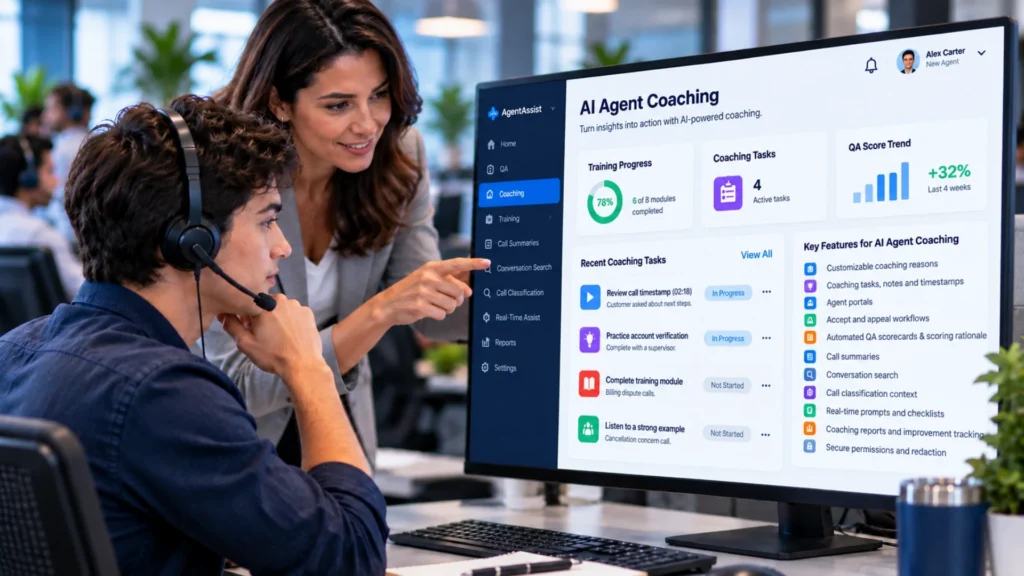
When evaluating AI coaching software for new contact center agents, leaders should look for tools that connect training, QA, coaching, and reporting.
Important capabilities include:
- Customizable coaching reasons
- Coaching tasks
- Notes and timestamps
- Customized agent portals
- Accept and appeal workflows
- Automated QA scorecards
- Scoring rationale
- Call summaries
- Conversation search
- Call classification context
- Real-time prompts and checklists
- Coaching reports
- Agent improvement tracking
- Secure permissions and redaction
The most important factor is whether the software helps supervisors turn insights into action. New agents do not need more disconnected data. They need clear guidance, practical feedback, and a structured path to improvement.
How AgentAssist.com Helps New Contact Center Agents Improve Faster
AgentAssist.com helps contact centers support new agents by connecting coaching, QA, call review, summaries, and real-time guidance.
Agent Coaching helps supervisors create coaching reasons, tasks, notes, timestamps, alerts, customized agent portals, accept/appeal workflows, and reports. Automated QA helps identify coaching opportunities through custom scorecards and scoring rationale. Call Summarization helps provide concise summaries for review and documentation. Real-Time Assist helps agents follow key topics and receive contextual prompts during live calls. Conversation Analytics helps supervisors search, filter, and review calls. Analytics helps managers track progress and trends.
Together, these capabilities help new agents receive better feedback earlier in the learning process.
The result is a more structured coaching system where supervisors can identify needs, assign action, track progress, and help new agents build confidence faster.
Final Thoughts
AI coaching for contact center agents is especially valuable during onboarding. New agents need clear feedback, real call examples, coaching tasks, timestamps, summaries, and guidance that helps them improve one skill at a time.
Traditional training is important, but it is not enough on its own. The real test begins when new agents handle live customer conversations. AI-supported coaching helps supervisors see what is happening in those conversations and respond with more useful guidance.
AgentAssist.com helps contact centers connect new agent coaching with Agent Coaching, Automated QA, Conversation Analytics, Call Classification, Call Summarization, Real-Time Assist, Case Management, and Analytics. That gives supervisors a stronger system for helping new agents improve faster, perform with more confidence, and deliver better customer experiences.
Key Takeaways
- AI coaching helps new contact center agents improve faster by connecting real call data to targeted feedback.
- New agents need more than training materials. They need call-specific coaching, QA feedback, examples, tasks, and follow-up.
- Automated QA can help supervisors identify where new agents need support across more interactions.
- Real-Time Assist can provide contextual prompts and checklist-style guidance during live conversations.
- AgentAssist.com helps contact centers connect new agent coaching with Automated QA, Agent Coaching, Conversation Analytics, Call Summarization, Real-Time Assist, and Analytics.
FAQs
AI coaching for contact center agents uses AI-supported workflows such as QA scorecards, call summaries, timestamps, coaching tasks, conversation analytics, and real-time prompts to help agents improve performance.
AI coaching helps supervisors identify coaching needs earlier, provide call-specific feedback, assign tasks, track progress, and support new agents with clearer guidance.
Notes and timestamps help supervisors point agents to the exact moment in a call that needs review, making feedback more specific and easier to understand.
Real-Time Assist can provide contextual prompts and checklist-style guidance during live calls, helping new agents follow important workflows and address key topics.
No. Coaching should also highlight strong performance, positive examples, and behaviors new agents should repeat.
AgentAssist.com supports AI coaching through Agent Coaching, Automated QA, Conversation Analytics, Call Classification, Call Summarization, Real-Time Assist, Case Management, Analytics, coaching tasks, notes, timestamps, alerts, agent portals, and reporting.
Ready to help new agents improve faster?
See how AgentAssist.com helps contact centers turn QA insights, call summaries, real-time guidance, and coaching tasks into a stronger onboarding and performance improvement workflow. Book a demo today.
Sources Used
- AgentAssist.com — Agent Coaching
https://agentassist.com/platform/agent-coaching/ - AgentAssist.com — Automated QA
https://agentassist.com/platform/automated-qa/ - AgentAssist.com — Real-Time Assist
https://agentassist.com/platform/real-time-assist/ - AgentAssist.com — Call Summarization
https://agentassist.com/platform/call-summarization/ - AgentAssist.com — Conversation Analytics
https://agentassist.com/platform/conversation-analytics/ - AgentAssist.com — Call Classification
https://agentassist.com/platform/call-classification/ - AgentAssist.com — Case Management
https://agentassist.com/platform/case-management/ - AgentAssist.com — Analytics
https://agentassist.com/platform/analytics/ - AgentAssist.com — Homepage
https://agentassist.com/